

Founder branding is one of the most powerful and reliable ways to compete against larger competitors with bigger marketing departments. What this approach lacks in scalability it makes up for in raw honesty. None of the larger companies you are competing with have access to your unique ideas and founding story. That counts for a lot, especially to the only audience that matters: your buyers.
Do you have a story to tell? We believe every founder does. It’s the reason you started your company. And yes, you can make time. Rather than contort yourself into chasing trends, formats, and schedules, you really can just do what’s most natural to you. Post when you prefer. Some people like to write. Some people are comfortable on video. Do whatever you can form a habit around.
In this article, we share a four-step process to getting started with founder storytelling that results in revenue:
- Craft a compelling founder story
- Determine what will resonate and define a process
- Build a distribution strategy for LinkedIn and other platforms
- Develop the “revenue hook” that ties back in
Let’s dive in.
This article is based on Scott Albro’s presentation in November of 2024. Scott co-founded TOPO which was acquired by Gartner, and works with companies like Microsoft, Google, ServiceNow, Procore, AppFolio, and hundreds of others to help them grow.
Founder brands are powerful—Yes, even in B2B
An objection we sometimes hear is that founder brands only exist in the consumer world. It’s true they are strong there. We can all think of a former startup associated with a single name—Steve at Apple, Mark at Facebook, and Elon at Tesla. Whatever those names conjure for you, they are at least somewhat continuous with the companies they helped create.
But it works just as well in B2B. Those companies are lesser-known because they’re the infrastructure behind the scenes, but we’d argue the association is equally strong. Consider: Tobi, Jensen, and Marc.
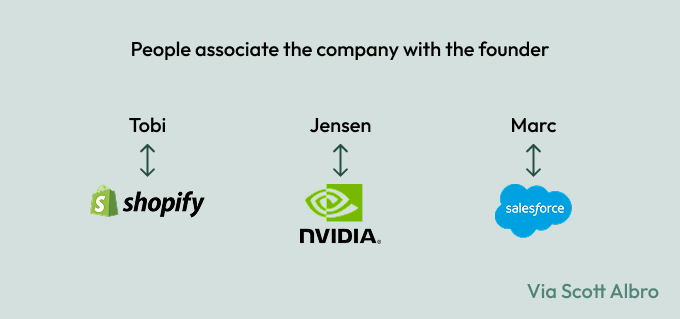
The more you niche down, the more founder brands emerge. Think of your own space and the minor celebrities there. I’ll bet plenty of people come to mind.
So what is the value of this association? It’s that it transfers any credibility you carry on a topic to your company. Your name precedes you. We can debate what a brand is or is not but for the purposes of this article, our definition is the market’s perception of us.
Our job when managing our brand is to actively shape that perception in a way that drives revenue. Revenue is important here. As a startup, you don’t have the luxury of building a brand for its own sake. Any associations you pursue must lead to people wanting to pay you. If it is working, you will know because your brand is driving meetings.
There are five ways a founder brand can help your company:
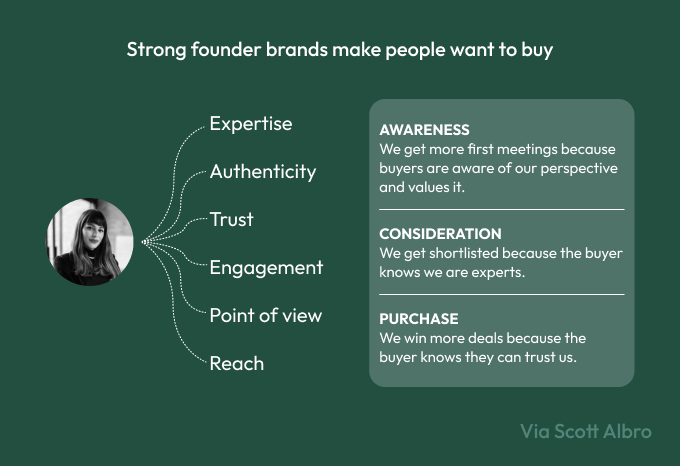
Founder brands make people want to buy from you.
Companies with strong founder brands have higher conversion rates and revenue growth because at the point of purchase, they already trust you. One of the top things people ask themselves before making a purchase decision is, “Do we trust this vendor?” That’s a proxy for the real question which is, “Do we trust the people behind this vendor?”
If you have a founder brand, it answers the question. If you don’t, then you have a lot more to prove because people don’t “trust” companies. Companies change. They’re faceless. Just ask yourself, who do we trust for various sources of information? What comes to mind? Likely it is people. You’ll have a much easier time shaping the market’s perception as your own distinct person, speaking at events and associating yourself with the field.
It helps you define your market.
If you are constantly writing and speaking on a topic, you’re flooding the zone with an owned narrative on how your buyers should view a problem area. It’s a way for you to shift or set the dominant narrative. People may start to mimic your language. You can put incumbents into a semantic corner, as Salesforce did by popularizing the term “on-premise software.” Before, there wasn’t a need for that phrase. All software was on-premise. But once it caught on, it put Oracle and other CRM competitors on their heels trying to explain why on-prem wasn’t bad.
It gives your movement a human leader.
Most movements are led by people. They need human leaders to be successful. You’re putting your highly recognizable face and voice to an idea that people otherwise wouldn’t have rallied around, and allowing them to associate you with that movement.
Social platforms are built to empower individuals.
LinkedIn is just one example, but instructive: Its feed gives ten times the promotional attention to posts by people as posts by companies. People can follow companies, but companies can’t follow back. Whereas two people can connect and their feeds grow intertwined; people interact with your comments and they’re shown your content. The growth patterns are all built around you being a person.
It’s great marketing that costs nothing.
It can cost literally zero budget, unless you hire someone to manage it. You can get by with just your ideas plus a LinkedIn account. It allows you to project yourself and your ideas at a great distance, inserting yourself into conversations and developing a following that becomes your initial demand.
All sounds reasonable. But of course, you’re a busy founder with little free time, so how do you do it? Here’s our four-step process.
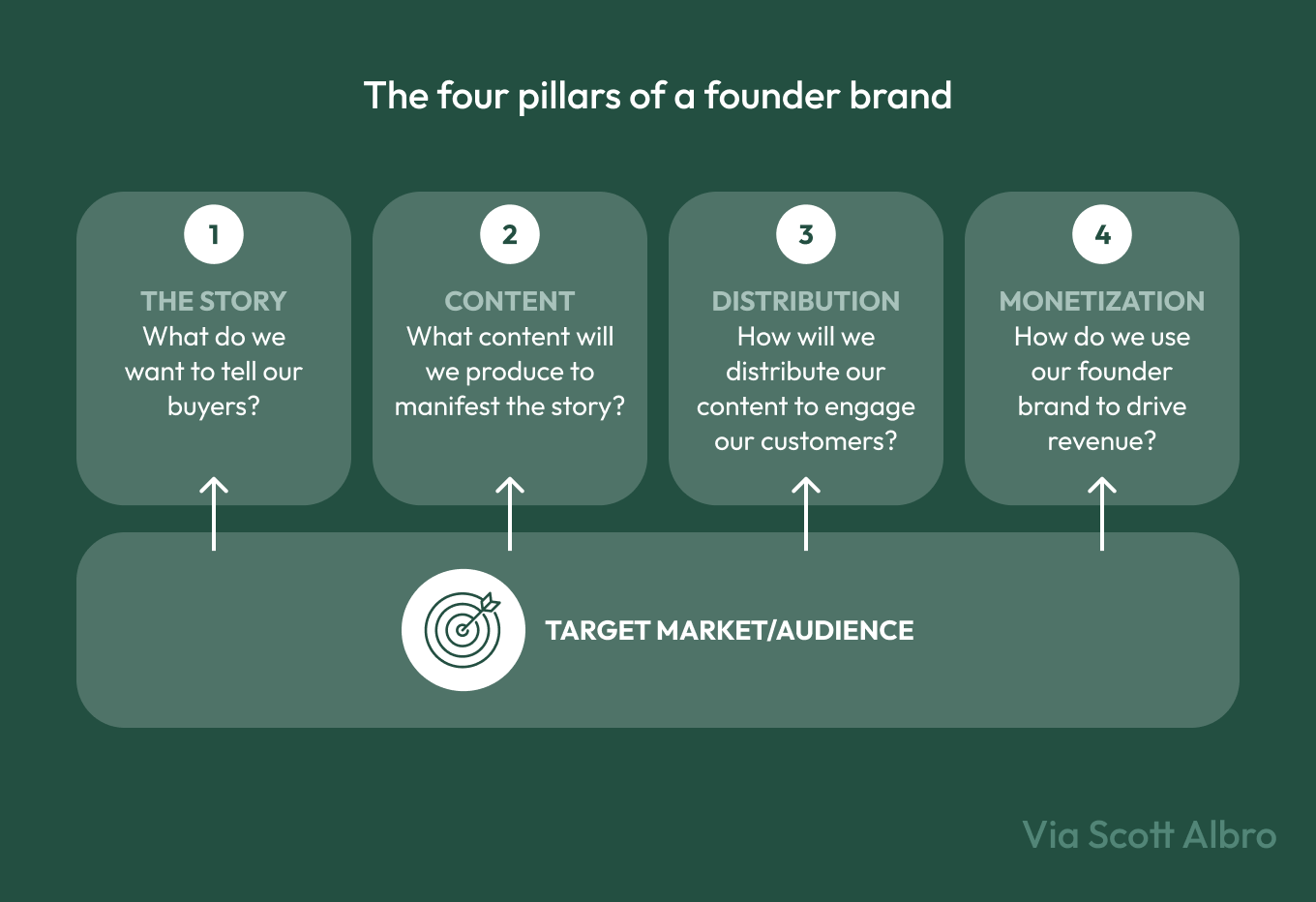
Four approachable pillars to building a founder brand
Perhaps you’re reading this and you’ve already unconsciously followed these steps. We think they’re pretty logical. But if you are missing any and aren’t thinking through the whole motion, it’s not going to generate revenue the way you’d hoped. You need all these pieces.
Building a founder brand presumes you already know who your target audience is. If you don’t know that, you can’t begin. How else are you going to know how to frame your story and whether it’s resonating? You’ll get lost chasing clicks from people who’ll never buy.
Let’s explore those four primary pillars in detail.
1. Story
Story is the most important pillar, though not the hardest. Every founder has a story to tell. Sometimes they need help pulling it out of them, but there’s a reason they started the business. We’d define a story simply as a true (or feasibly true) account of something your buyer finds compelling and eventually leads them to want to buy.
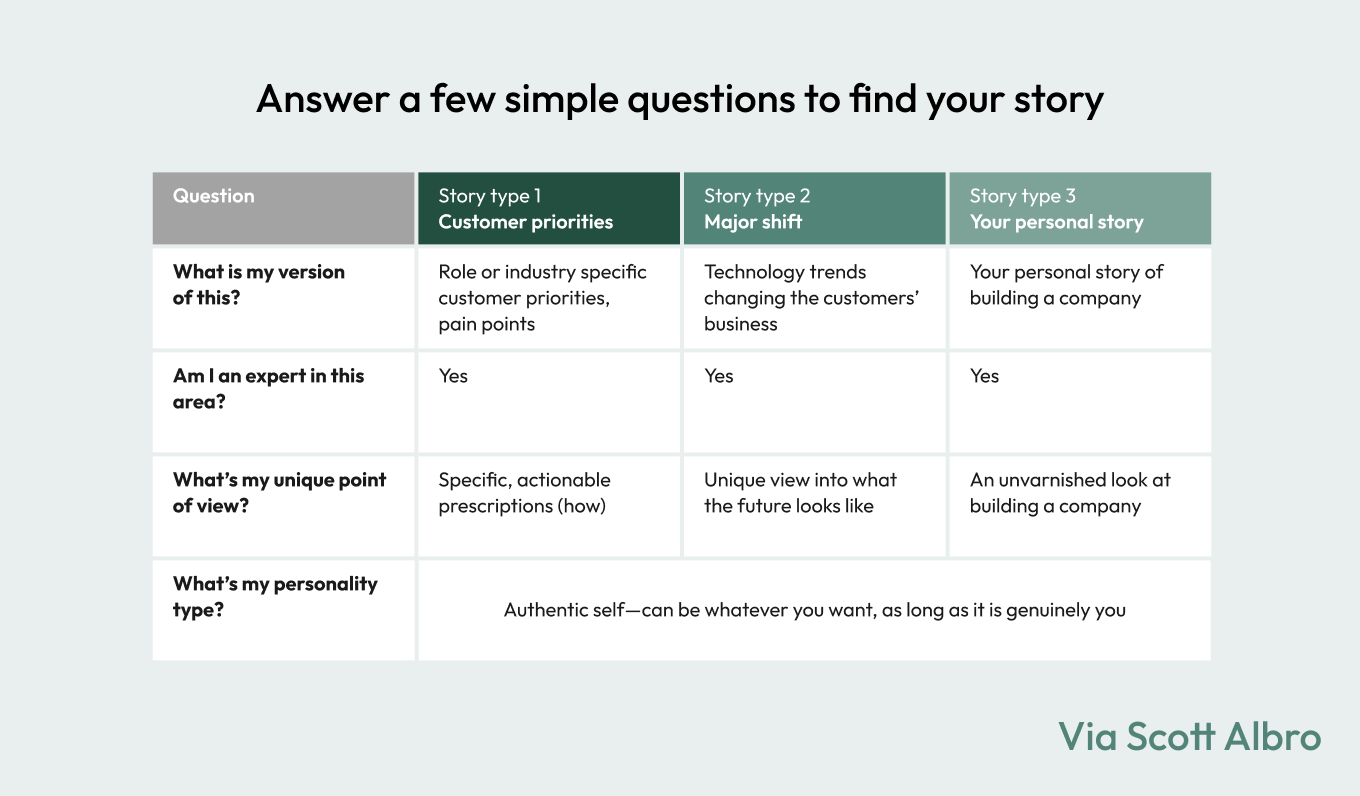
There are three categories of story you can tell:
- The customer’s story and pains
- A transformative shift
- Your journey as a founder
Not too complicated, right? We think you’ll find most stories you want to tell and are relevant to your audience will fit those buckets or spread across multiple. For example, let’s say you sell software to pizza shop owners. The three stories you might tell are:
Pains: “I spoke with seven pizza shop owners in Brooklyn. Their top issue is managing order flow during peak hours, 6-9pm.”
Transformation: “Most pizza shop owners we talk to are upgrading their systems and making more on deliveries as a result. In the future, AI will do the dispatching. Are your systems ready?”
Journey: “After college we opened a pizza shop. We didn’t know what we were doing but we wanted to make great pizza. Ten years later, I’m supporting owners in not making the same mistakes.”
How you tell that story matters just as much as the story itself. Readers must believe that you have some unique and specific alpha that nobody else knows about. You see a future no one else can see. We find taking a contrarian mindset helps with this. If everyone’s joining in on why AI is the future, explore credible reasons why LLMs might be a stepping stone to something better. (Careful not to stray into trolling or clickbait.)
You also want to tell a big story. Small stories are about work tips and how-tos. Big stories are about a shift in a market. It’s about tectonic shifts, new worlds, and how things will never be the same. At a past company, we spent a lot of time trying to convince the world that one day, software would be hosted. That you wouldn’t need a CD. Big stories sound audacious at first. They become real through repetition.
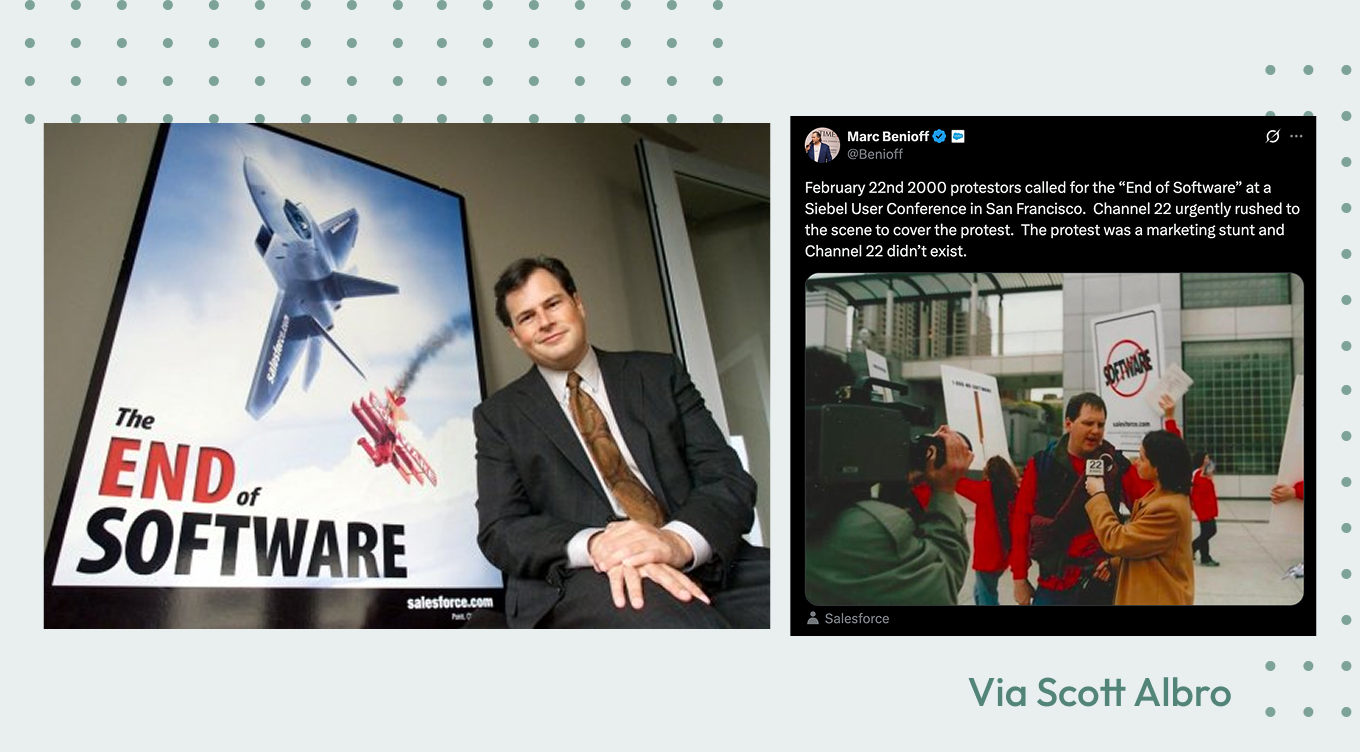
One of the best ever at this was of course Marc Benioff. His early stories fit the three types: Customers had a lot of pain managing software themselves. He was reflecting that back and talking about how to transform—Salesforce would host it in the cloud and it was as easy as turning on a light switch. And he made it personal. He’d worked at the big incumbent, Oracle, and he didn’t like their CRM. He wanted to beat them.
To find your story, create a table and fill in the spaces.
2. Manifest
In the manifest phase, you actually write your stories. It might surprise you but the founders who are best at branding write it all themselves. You are the source of all that experience and all those anecdotes and if you can get that out, that’ll resonate more than something polished by a writer. (Usually.)
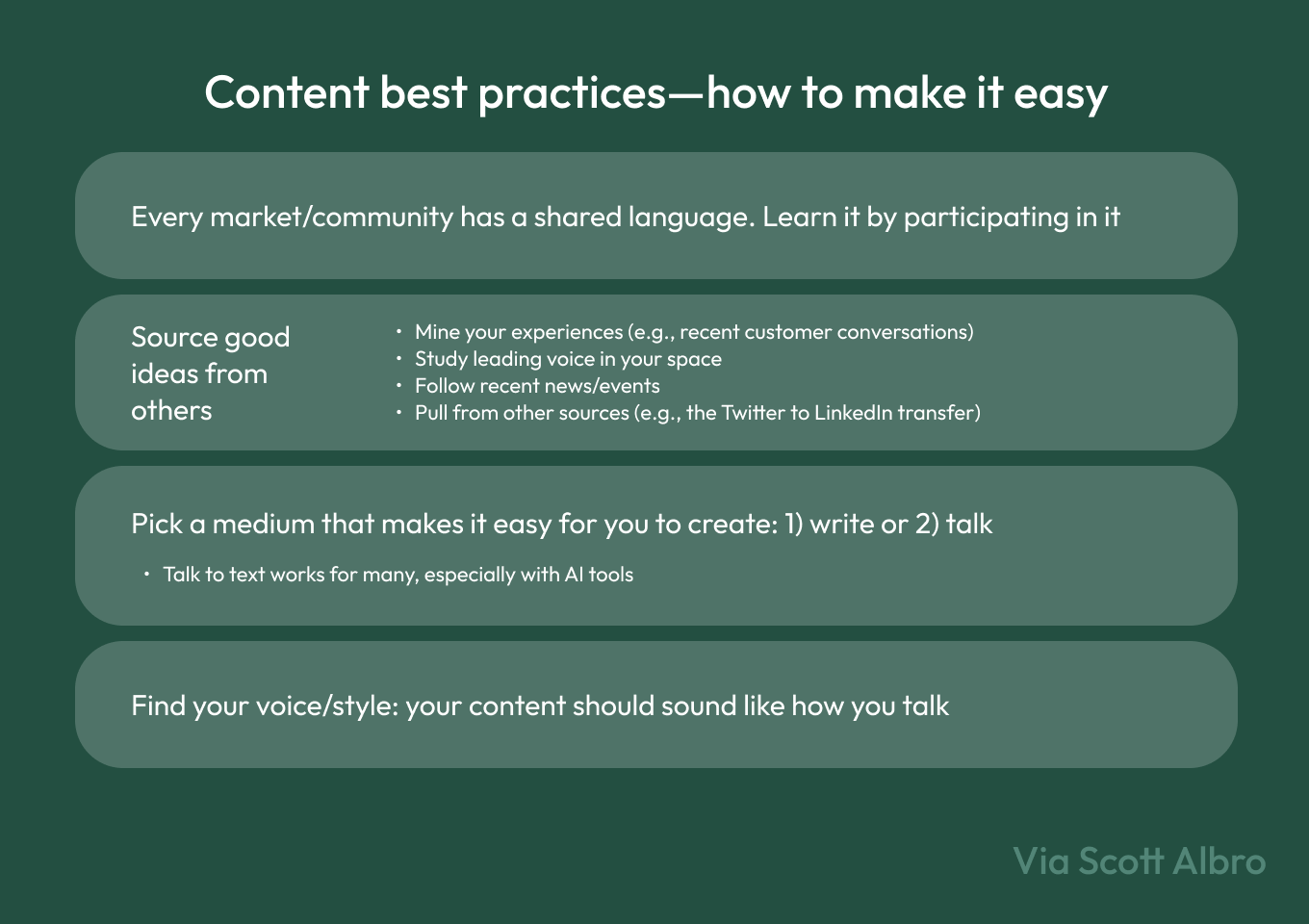
Your buyer has a shared, industry-specific language and you must learn it. We find this is actually pretty easy—simply spend time in their spaces. You’ll pick up how healthcare companies talk about “lives” instead of “employees.” They’ll say, “We helped a company with 10,000 lives.” Some of this is unspoken. You pick it up by participating.
Layer those little linguistic nuances into what is more or less just what comes naturally to use. Founders get hung up trying to sound like somebody else. Don’t. Writing like you talk is the best starting point.
Source good ideas
Lived experience is the best source of content. It’s naturally unique and generally interesting to readers who want to know what others in their space are saying. Look on LinkedIn and you’ll see a lot of, “I just talked to an entertainment CEO,” because it works. Board members, employees, customers, it’s all material. Just be careful to anonymize.
Become a source of information
You can go far simply by curating. Many great newsletters are just a smart person gathering links, and there is value in that—it saves readers a lot of time. A founder we know wakes up and reads the Wall Street Journal and jots down a few ideas. It’s a cheap trick, but these things happen on Twitter and TikTok before LinkedIn. Be the one to share it.
Hitch yourself to stories already being discussed
This sounds like it goes against our “be unique and personal” advice but it doesn’t: You can have a unique, contrarian take on a major event. Everyone’s already reading it. And if “everyone is talking about it,” shouldn’t that also mean you? Tell them why they may be reading it wrong or what you see that they don’t.
Stories can be video or audio too
The best medium for founders is the one that feels the most natural. Don’t overthink this. (Though it does change where you post—video doesn’t fit everywhere that text does.)
The most valuable content does not always win
In a utopian world, it would. But in this reality, you must create valuable stories and then apply the cheap tricks that work on the internet. On LinkedIn, add two line breaks after your opening hook so people have to click “See more,” which juices the algorithm. Use photos. Share numbers. Share data. Be provocative.
Note: Just because a post is easy for you doesn’t mean it isn’t high value. Sometimes the stuff that performs the best requires the least.
Create on a cadence that feels natural
Some people like to batch a bunch of posts. We like to write as ideas arise. Do what works for you. Just stay consistent.
A great place to start: Write a canonical article
To get the juices flowing it can help to start by writing a long manifesto. Get all those ideas out. Writing is thinking. You’ll learn as you go. If it’s good, it will be infinitely decomposable into social posts. For a good example, read Machines of Loving Grace by Dario Amodei at Anthropic.
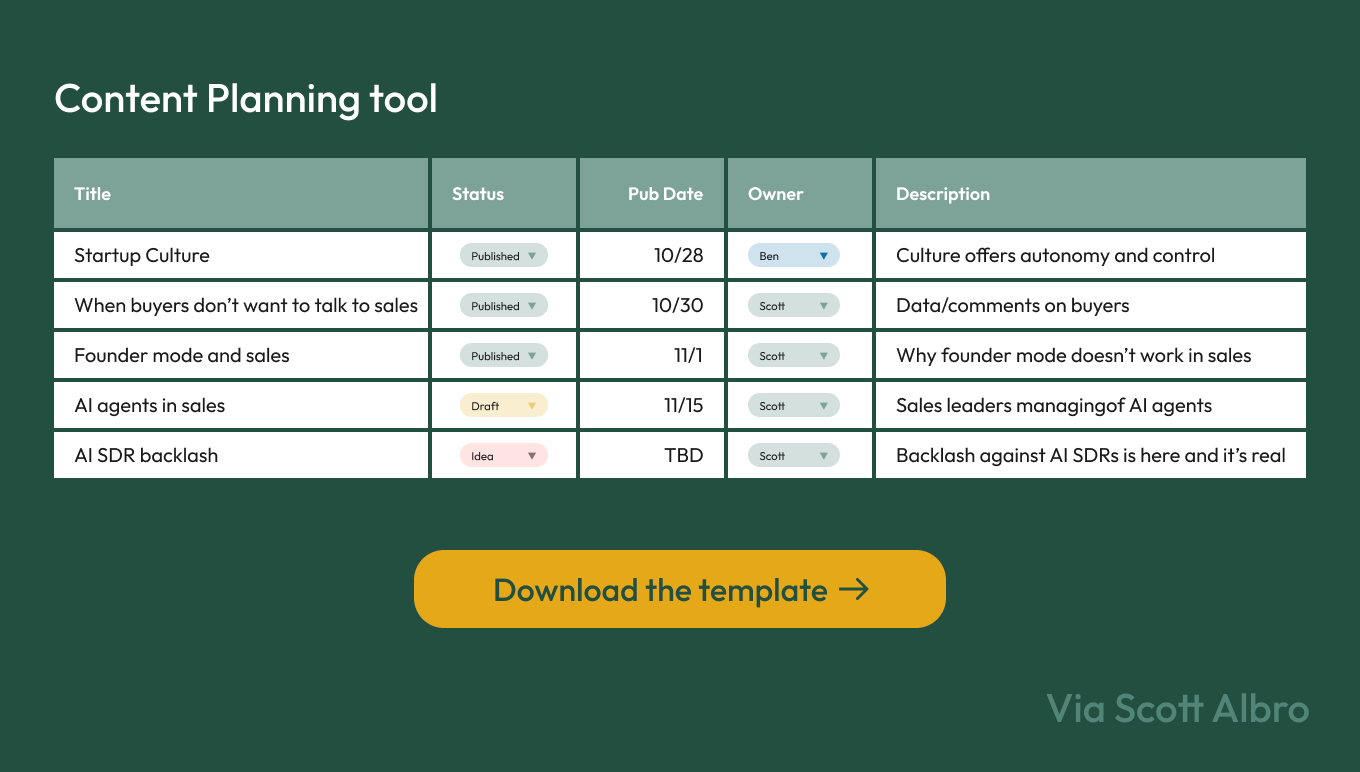
Build a content planning tool
Steal this template. Use it only insofar as it makes things easier.
3. Distribute
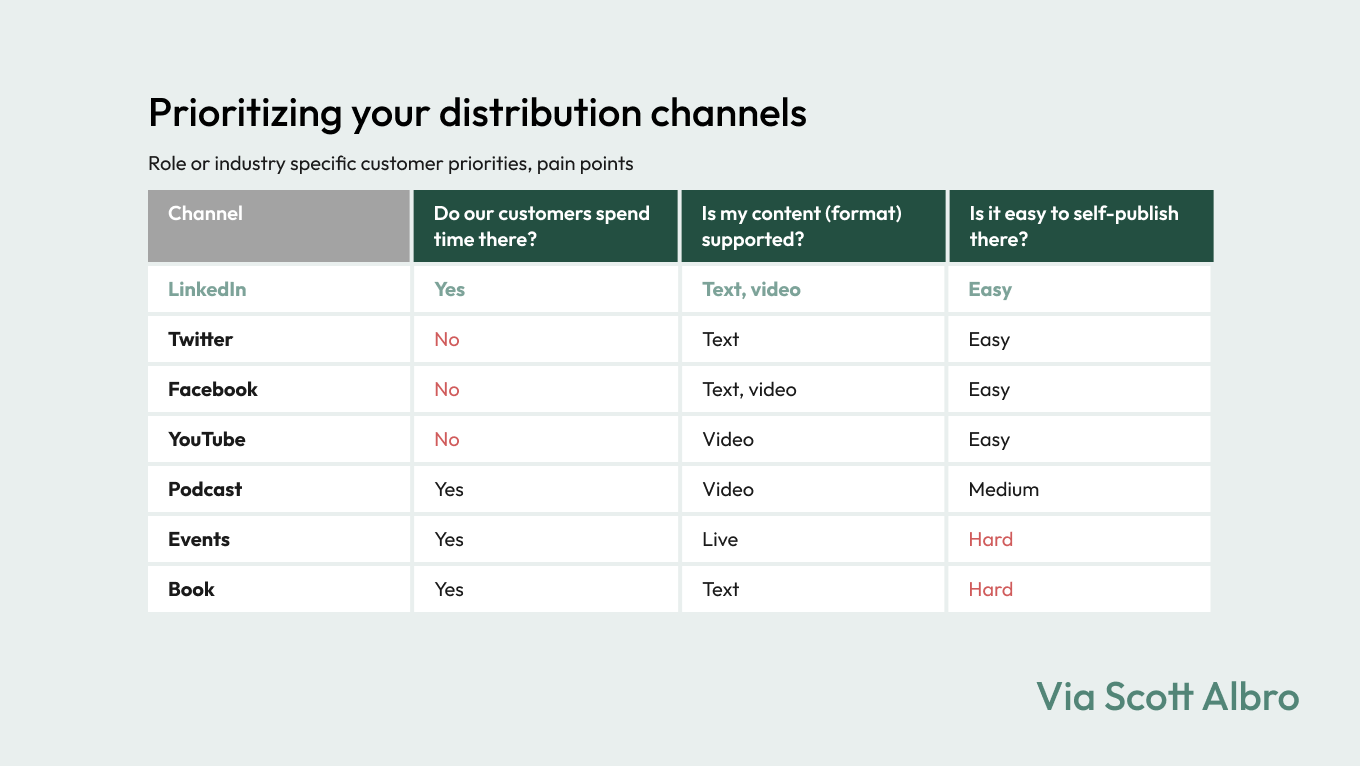
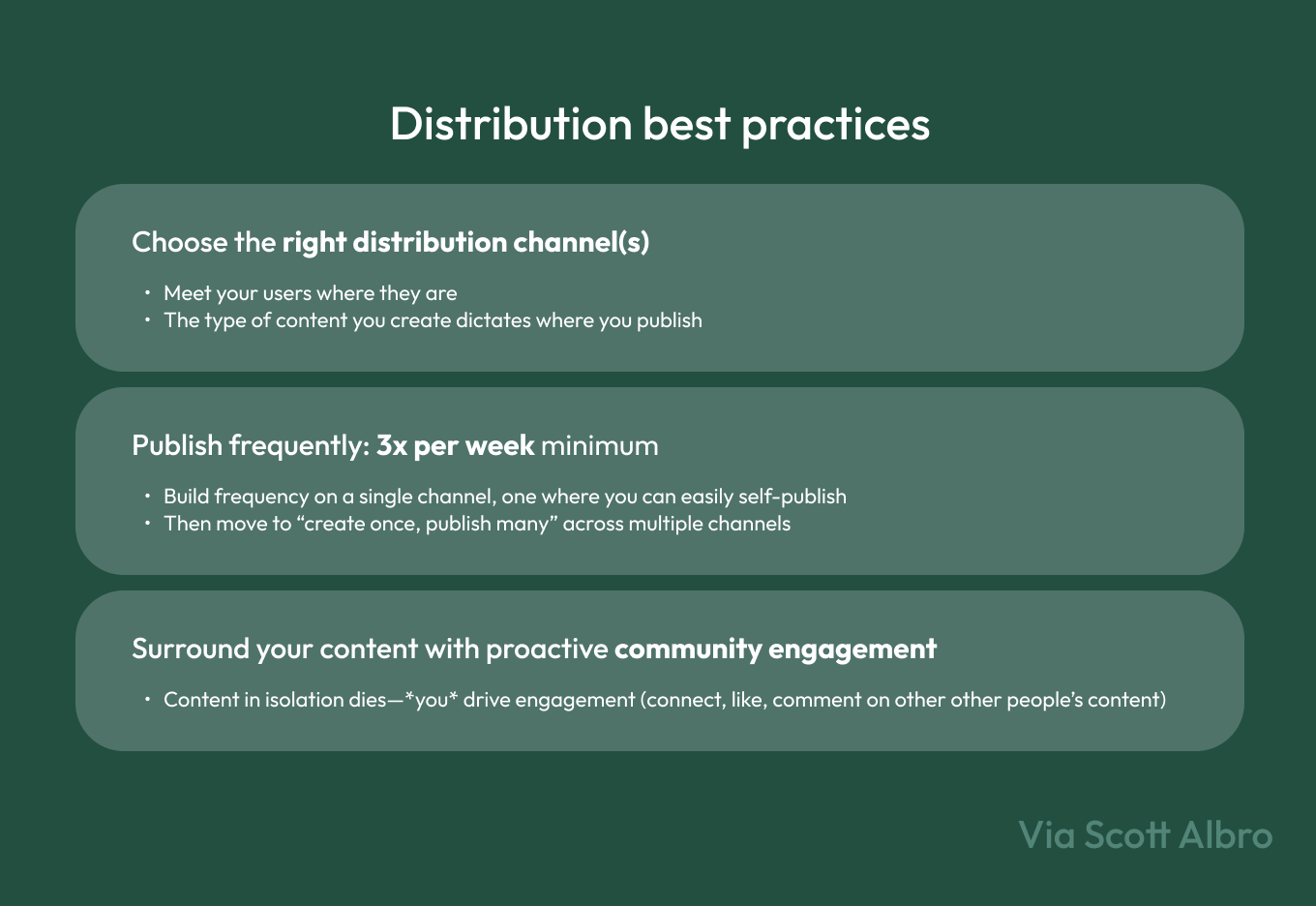
Next, get your stories out to the people who fit your buying archetype. For most, this will mean posting to LinkedIn and a few groups you genuinely participate in. But do choose one primary channel and focus there. You can’t start out optimizing for four algorithms/cultures. Do one thing well before you do more.
Post at least three times per week. More is better, but multiple times a day is excessive, unless you really enjoy it. There’s a diminishing return.
The best channel? The one where your users already are. You’re a founder brand of one. You don’t have time to change people’s behavior. Enter conversations already in motion.
Distribution is not just about shouting into the void, either—you really have to engage your community. Content in isolation dies, and nobody reads the people who only post but never reply. Respond to every single comment from a relevant individual in a timely fashion and spend half of your time tagging others and leaving comments on their posts. LinkedIn throttles the reach of your posts. It does not throttle the reach of your comments. Your comments could get you more reach than your posts and bring people back to the content you want them to see. It may go without saying but comment substantively. There is no point in commenting for the sake of commenting. Advance the conversation.
For a great example, look at Sam at Pavillion. He publishes 12 times a week. That’s probably excessive. But he hosts go-to-market communities and so it’s really a perfect fit. He hears things, he shares things, he learns more, and he posts again. That’s a nice feedback loop, with relevance and credibility wrapped up in one.
4. Monetize with your revenue hook
The final pillar is connecting your posting back to your startup’s sales. The most important thing here is to follow up. You may laugh but we have to say it because people don’t do it. They post then get busy and waste all the inbound interest from people who fit their ideal profile.
From there it’s a funnel. Form lots of high-level friendships with people who engage with your content and then reach out via the medium they used to engage you—direct message or email—and tell them what you’re up to and ask if they’d like to hear more. You can have a sales development rep manage this, but that first note must come from you and be short and personal. Say, “Hey, we saw that you liked that piece of con our post from yesterday. Would you be open for a meeting just to talk about what we’re building here? Please meet so and so.”
And that really is it. If you have followed all the steps so far, this will drive meetings. We see it happen over and over.
Really, don’t overthink it
Every founder with an amazing brand was at some point randomly posting whatever came into their head—just like you’re about to do. We’d argue you can’t write a more specific playbook than the one we have because most of this process is what it teaches you about what people resonate with and react to. There’s no way through it but to go through it. So long as you keep that monetization focus, know your audience, and listen, you can build your own founder brand. It doesn’t have to be as big as Tobi’s, Jensen’s, or Marc’s to get you what you need.