

Two things can be true at once: AI is cannibalizing organic search traffic and Google is still sending 20 times more traffic than all AI incumbents combined. It is a confusing time. Do you abandon organic search before it collapses and optimize purely for AI crawlers, or double down on the old methods as the decks clear?
Perhaps it’s useful to remember that declines based on consumer habits occur in slow motion. Yahoo! is still around in 2025 and BlackBerry still has a market cap greater than most AI companies. SEO was a great deal ten years ago. Now it is less of a great deal, but still a good one, and possibly worth the investment. The goal of organic search for startups is and always was about building an owned audience with high-authority, high-quality, low-friction content your buyers actually want to read, and capturing those emails to feed your other programs. That hasn’t changed.
The SEO process has grown more complicated, however, and this article offers a strategic update. It is based on insights from John-Henry Scherck, CEO and Founder of Growth Plays, a demand and content agency that works with venture-funded startups. He would encourage every reader to think of SEO not as some box to check, but as an essential channel in your demand engine.
Serve your buyer first
There has been a lot of poor SEO advice over the years and none so misguided as “write for the algorithm.” The algorithm is carefully watching what real people interact with; it is primarily guided by people. Google’s latest updates solidified this and it now harshly penalizes keyword stuffing.
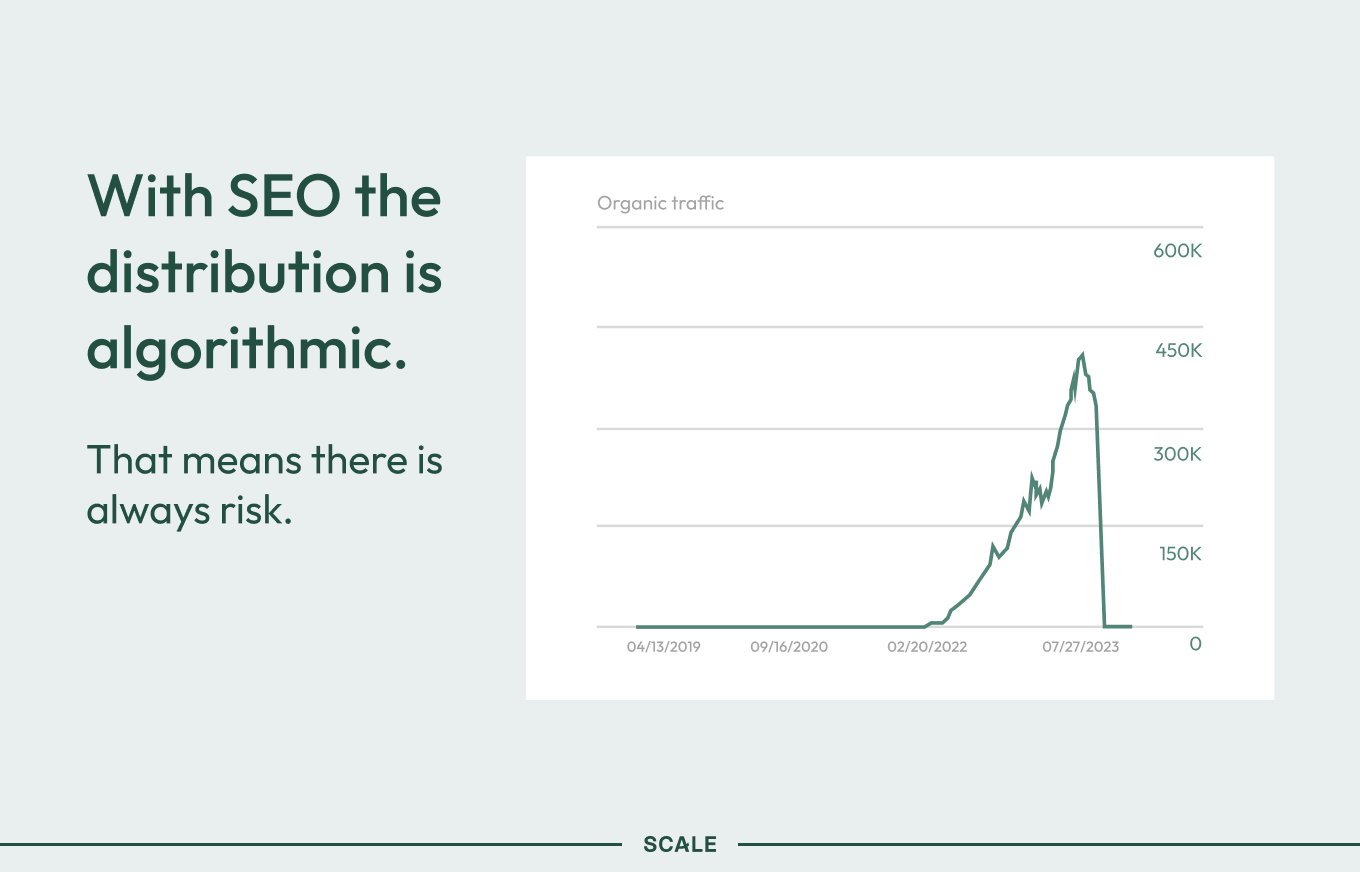
This means any company trying harder to game the algorithm than to serve readers will tend to face occasional cataclysmic drops in traffic. One company Growth Plays spoke with had spun up thousands of pages full of low-quality, AI-generated content. When Google released a major algorithm update, the company’s traffic plummeted from half a million monthly visits to virtually zero.
Whereas other companies benefited from that same Google update, which gave greater priority to content that demonstrated “experience, expertise, authoritativeness, and trustworthiness.” These companies had been less focused on figuring out the nuances of the channel and more on writing things that served their buyers.
That said, writing faithfully is still no guarantee of success. There is always inherent platform risk in relying on a stranger’s algorithm for distribution. Algorithms can change. This is why serving your buyer content they truly value is so important: If you can capture their attention, you earn the right to take them out of search (or AI) and integrate them into an owned audience.
Use SEO to build an owned audience
Traffic is ephemeral, and the point of appearing in search is to convert people to buy, try, or join your owned audience. You want to cut out the algorithmic middleman. To do that, you must, of course, collect names and emails, but not by the now tired style of gated PDFs. Buyers have higher expectations, and you must offer something so useful that people actually want to subscribe and stay subscribed. The burden for quality is higher and the tactics that got your team here won’t lead you through the next decade of SEO.
What is coming from the next decade of SEO? Significant changes in format and somewhat less dramatic changes in strategy. Search is growing more fragmented and converting visitors is more difficult. AI will cut into traditional search traffic. More traffic will accrue to those few first results with preexisting authority. Yet at the same time, many of these challenges aren’t especially new. Just more pronounced. The key has always been to deliver high-value content that readers find useful or entertaining or both.
One dimension of that challenge is that startup marketers have long created downfunnel search content that assumes all buyers are in-market all at once. But just 5% of your audience is in-market. So what are you creating for the other 95%? That is the content marketing challenge, and we’d encourage you to be creating content useful to your buyers’ roles year round.
Review your own marketing. Is it all about your product and driving sales conversations? Consider expanding what you publish; focus more on authoritative, useful information so your audience joins your list before they begin evaluating.
One more impediment: Search is, by now, highly saturated. John-Henry believes you must be an established firm to compete on common, highly sought-after terms. A startup trying to rank for “best project management software” has almost no hope of unseating Forbes, whose article has hundreds of backlinks.
Whereas if you are creating a new category or leading an emerging market, SEO may be well worth it. There, the dynamics may still feel like the early heyday of search. You can win on your terms with a reasonable amount of effort for a Series A-sized team.
Google rewards instant gratification
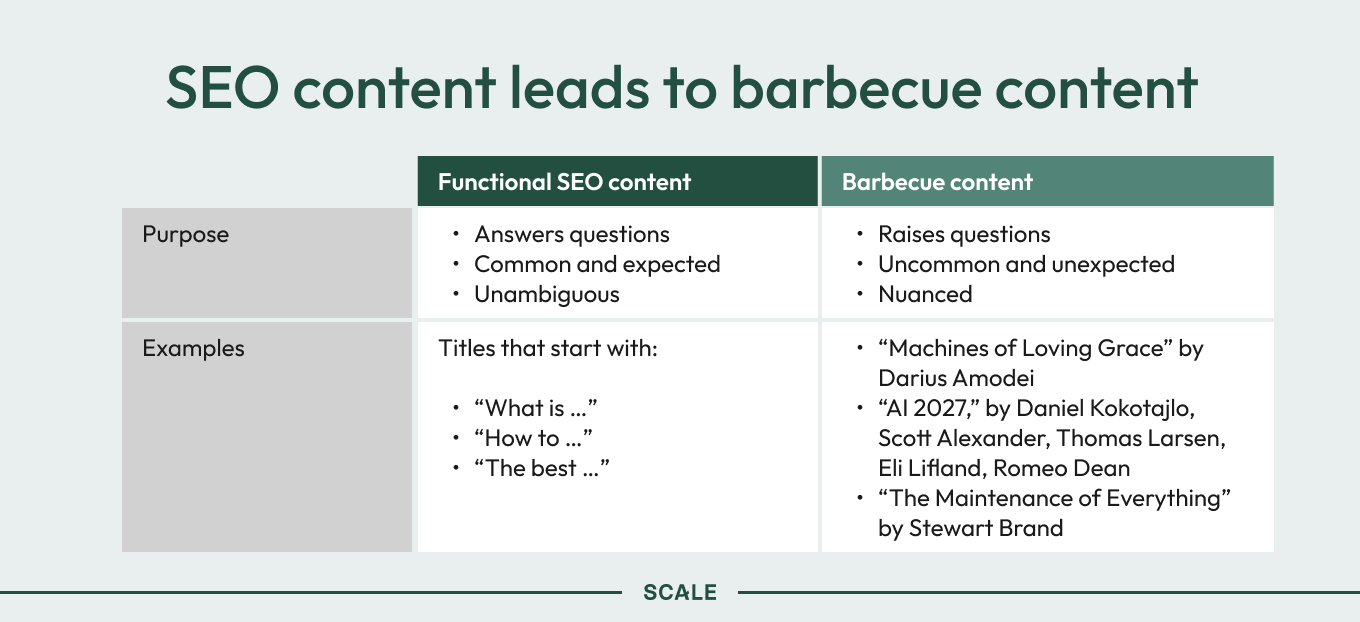
The Google algorithm is obsessed with delivering what people expect to find, not what they necessarily need to hear. Over time, we have seen it increasingly focus on surfacing answers that are:
- Similar to what already exists
- From brands it already trusts
- Shaped into easy answers, not challenging questions
This is not great news for new entrants into a market, who want to challenge the dominant narrative. Even while their challenger message may make for a more interesting read, Google would typically rather give people what they are after.
Additionally, as the search layout has evolved, there is less traffic going to organic search results than in previous years. Companies that Growth Plays works with have continued to hold their same rankings but are seeing less—although still substantial—organic traffic to each.
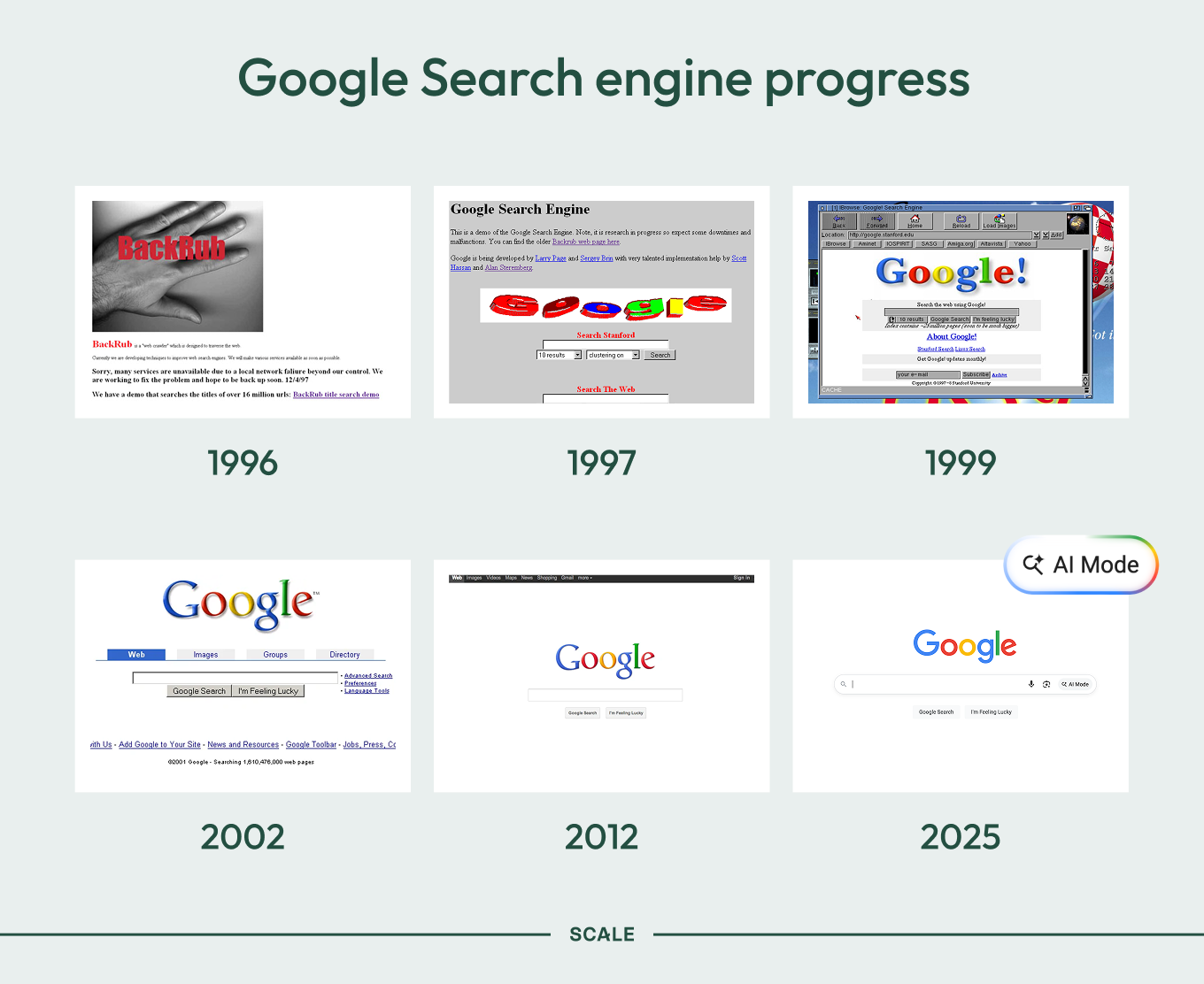
Less traffic is actually a case for investing more in high-quality content narrowly tailored to your buyer. The top spots are more competitive, and mediocre content that would have worked early on in SEO no longer achieves much. Focus on creating expert content that may rank lower, but which builds a loyal following.
Typical SEO content may not generate meaningful conversations, so you want to use your SEO content to push people toward what’s called “barbecue” content, or content people would discuss happily at a barbecue. Barbeque content is niche or new and therefore doesn’t rank well, so you use one to get people to the latter.
How modern buyers search
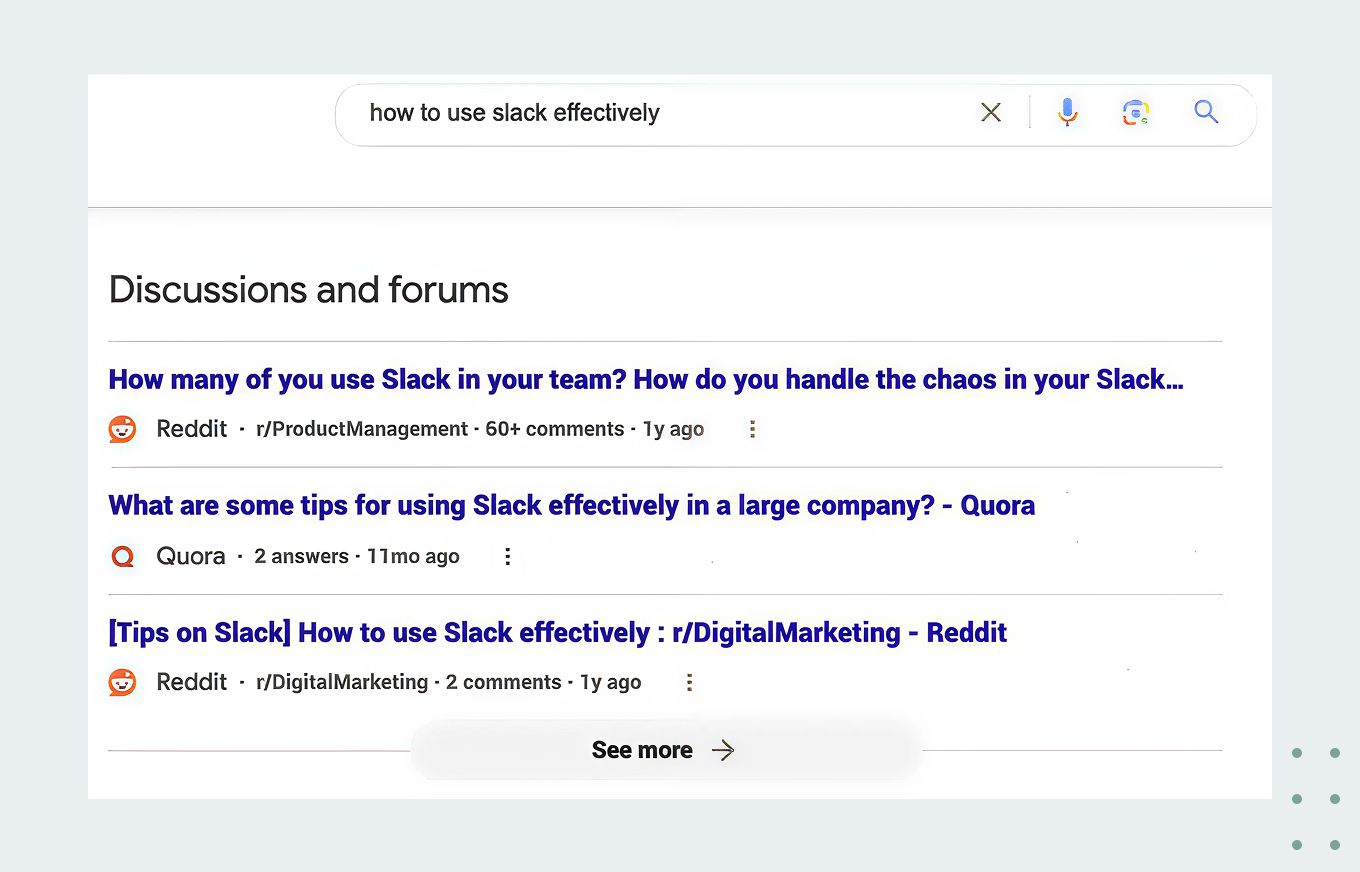
There are still many misconceptions about how buyers search for products online. John-Henry would encourage you to look at your own search history. Rather than the logical, methodical paths marketers like to depict on whiteboards, real queries form only a loose scatterplot. Searches for “invoicing software” are interspersed with searches for celebrities and how to convert a video into a GIF.
Even better than looking at your own history, ask a peer who fits your ideal persona to let you view theirs. Pictured is an example of someone in the market for a new CMS, but who is looking for ways to compress images and improve site speed.
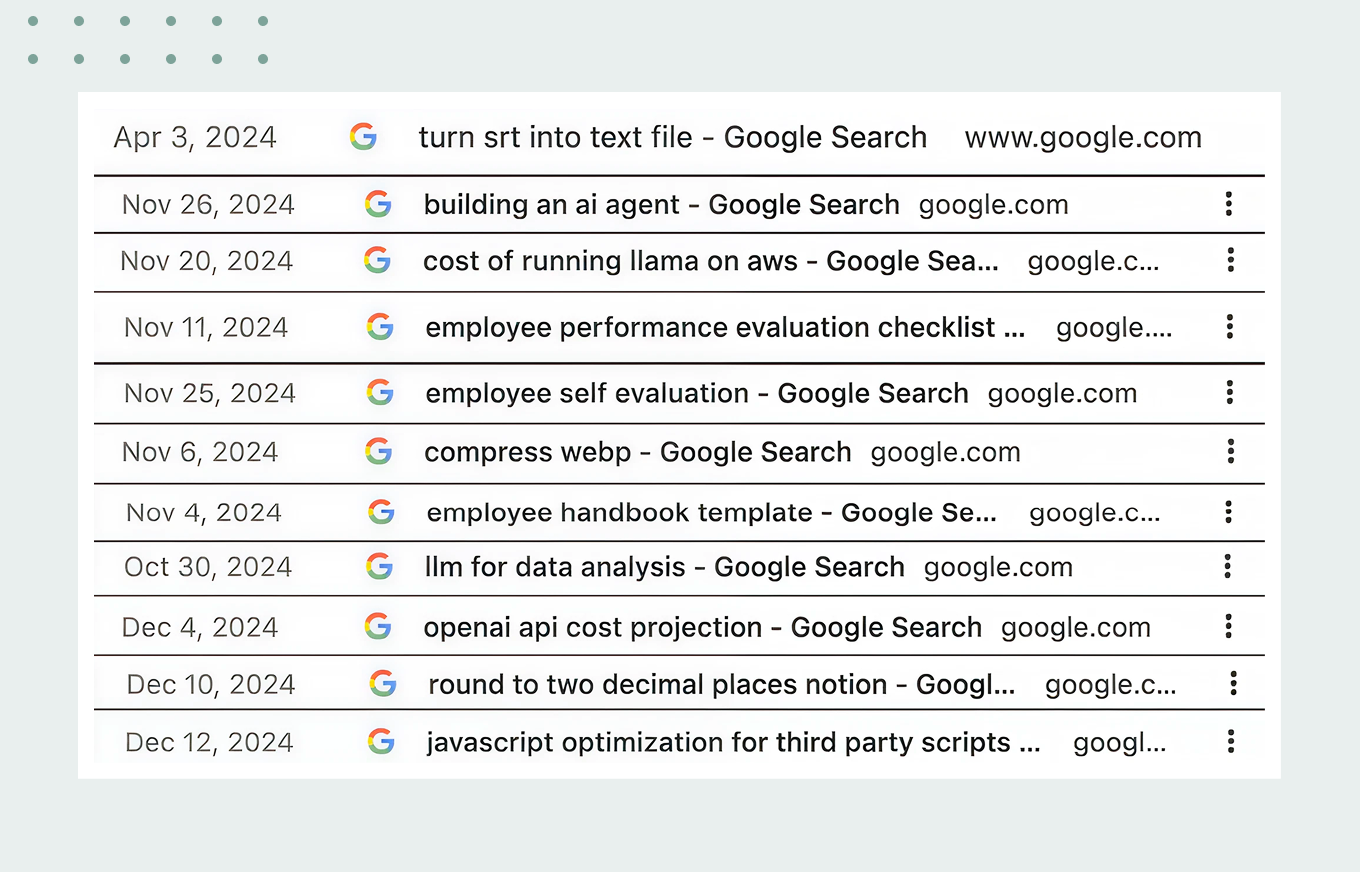
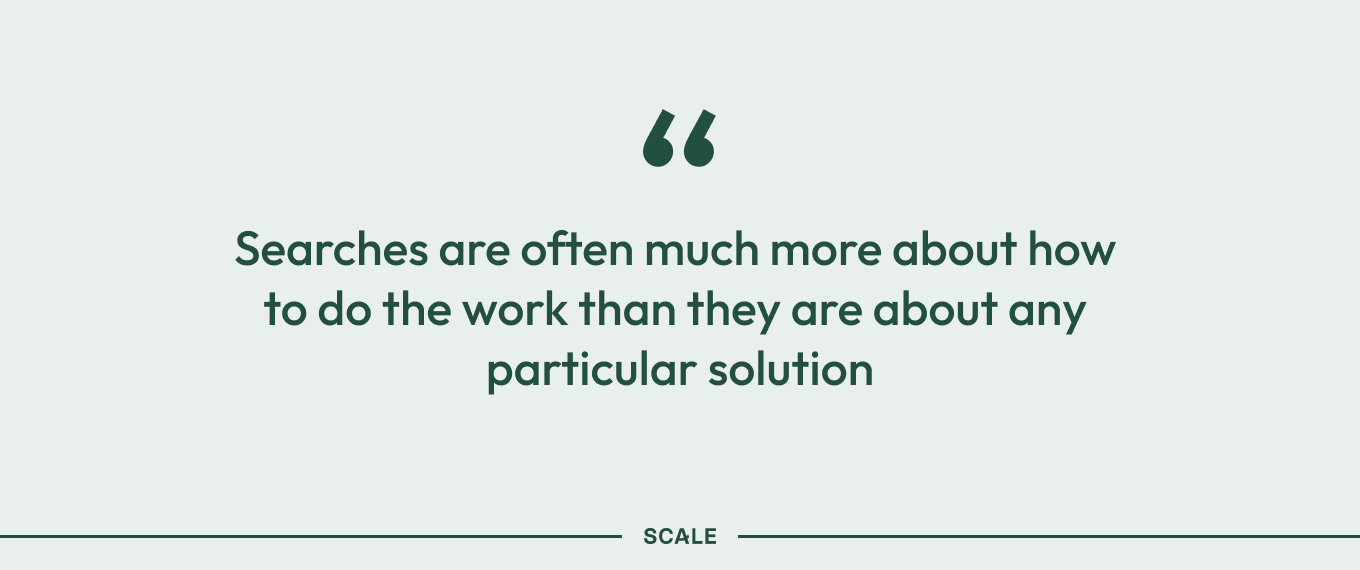
All to say, searches are often much more about how to do the work than they are about any particular solution.
Perhaps you are thinking that writing about how to do the work sounds undifferentiated, and it may be. Attractive keywords today may be tomorrow’s AI-summarized, zero-click search results. This is a tricky balance to navigate and one to work with an SEO professional on, but our advice would be this: Contribute such helpful, authoritative, stark opinions that others are afraid to summarize, and instead quote you.
For example, AI will likely summarize the term, “What is a go-to-market team?” But the variation, “The best way to staff a go-to-market team,” is so context dependent and so reliant on firsthand experience, you are more likely to serve up valuable information into the future.
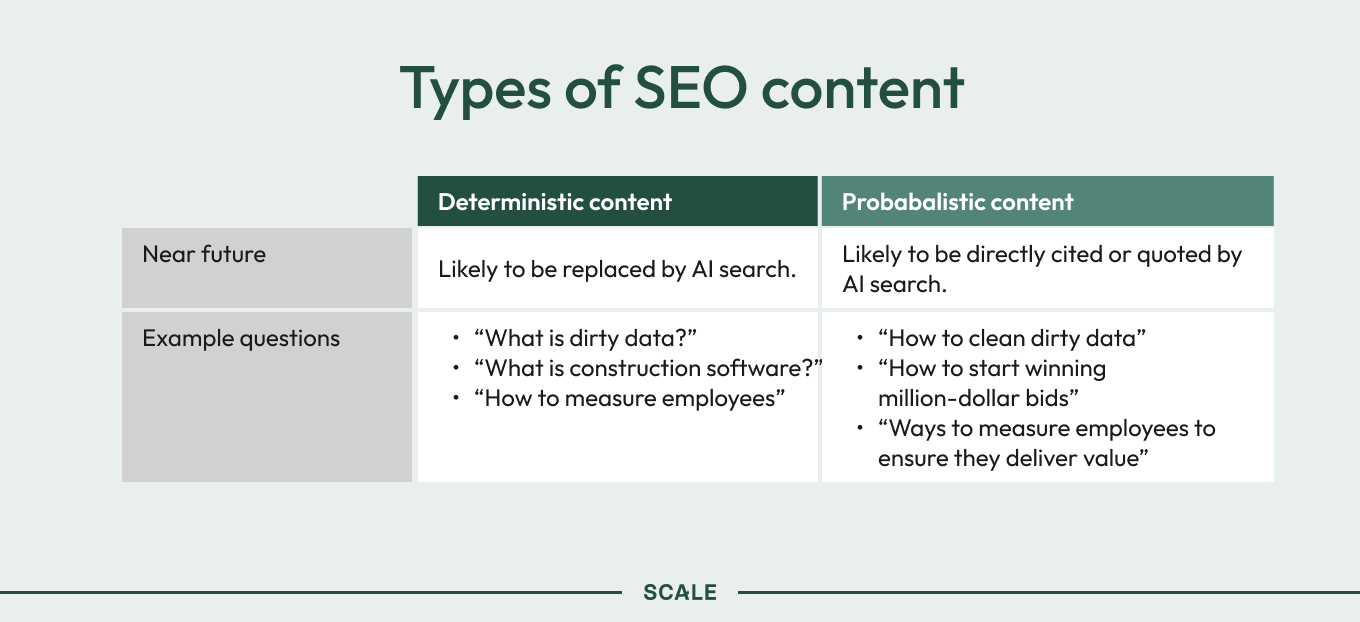
If you want to write effective probabilistic content, avoid SEO content-checker tools like Clearscope. They are built on the faulty assumption that what has been will continue to be, and they can only tell you that other content has certain characteristics—not that yours will succeed if you do the same. Those tools push your team to write generic, unspecific content that alienates actual humans. This type of content is why people are discussing “the death of SEO”—they are unsatisfied by all the clunky, derivative articles that are just a mishmash of what everyone else wrote on the first page of Google.
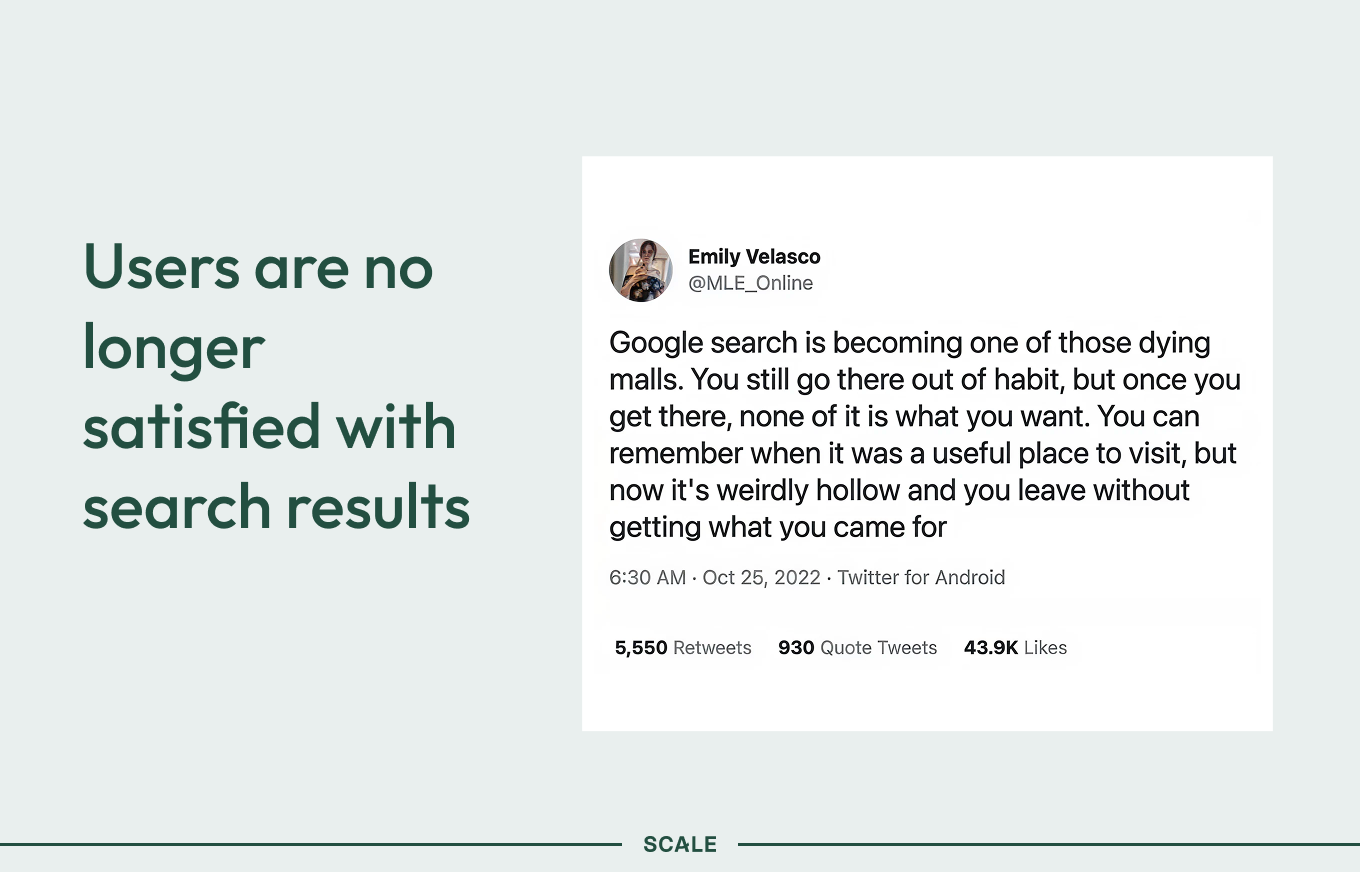
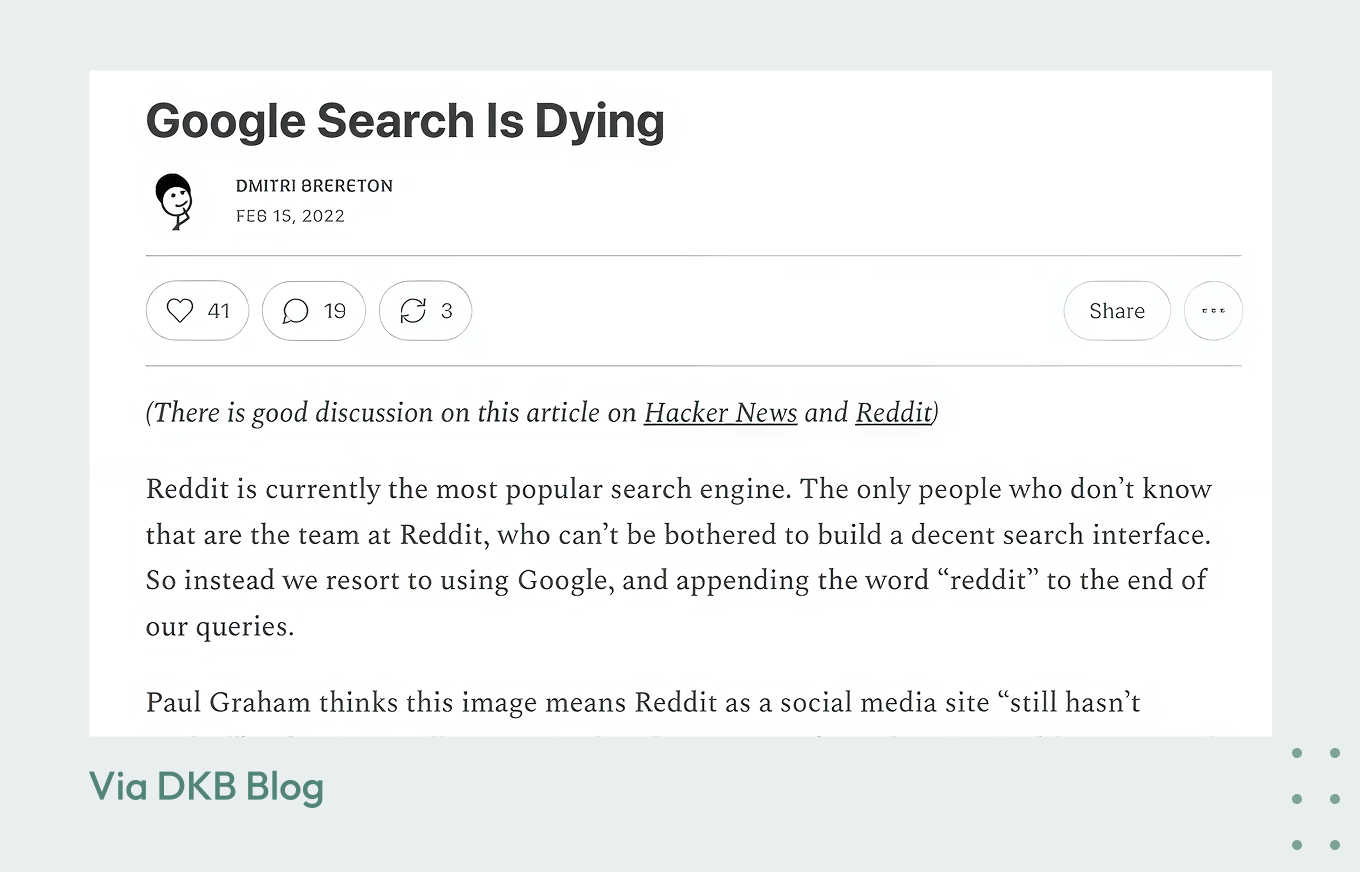
That broad dissatisfaction with garbage-filled search is behind the rise of AI summaries. AI search won’t be the end of SEO traffic, but it will mean a decline in some terms and require adaptation. But it also means that the bar is low, and you have a shot at ranking if you genuinely have more expertise to share.
Create a portfolio of content types
We discussed barbeque content, but there are other types. The company Fonoa, as just one example, automates tax forms for marketplace suppliers and publishes in three categories: Breaking news, evergreen resources, and memes.
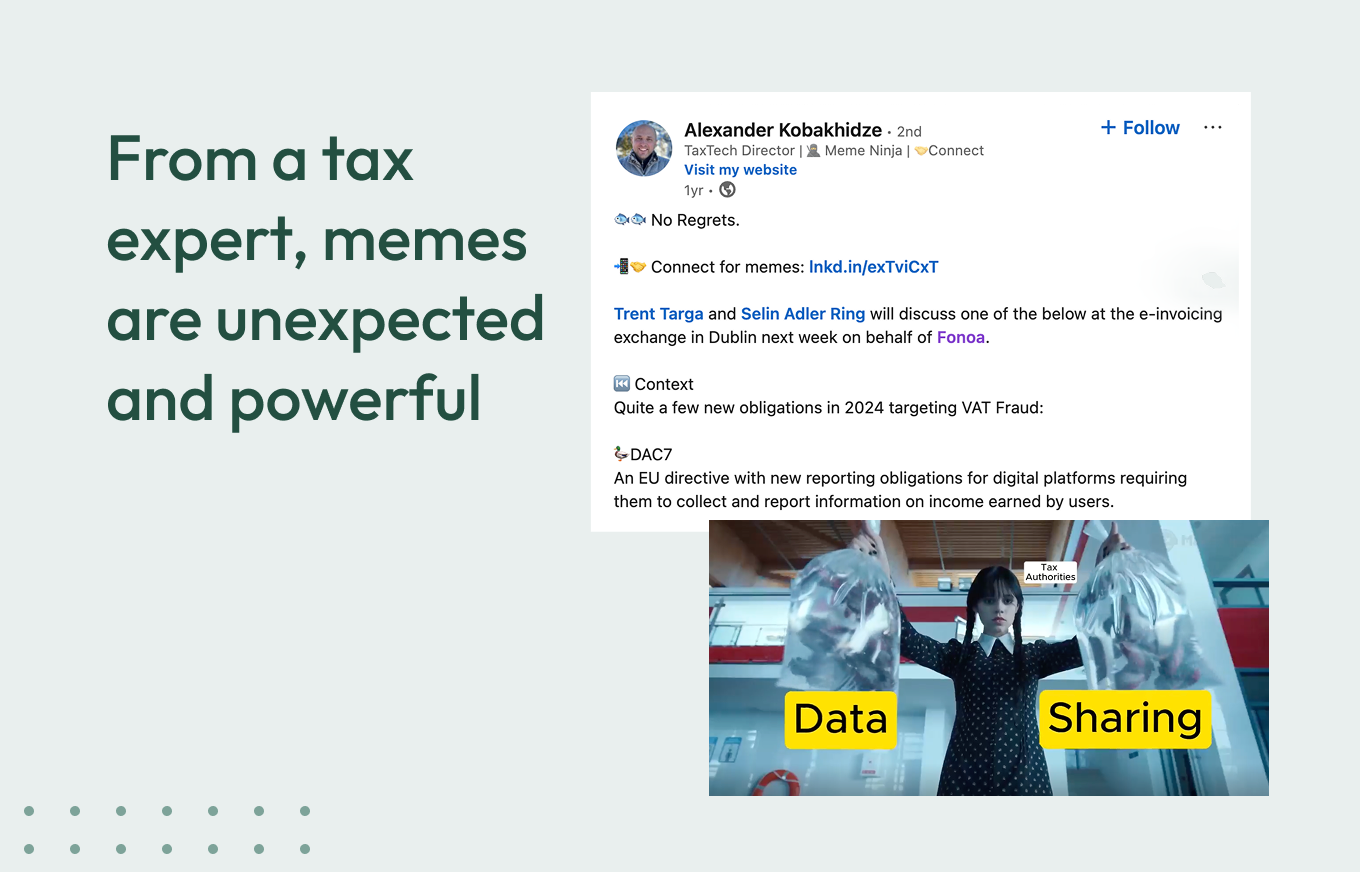
Fonoa noticed a gap in tax news from foreign countries, and its marketing provides a valuable service: It aggregates international updates into a tax regulation feed. They are “wrapping” others’ news into their own context, which is just as valuable to time-starved buyers as if they had invented it on their own. They also produce evergreen, traditional SEO-type content around running a tax-compliant business, but also memes, which are unexpected and fun.
The memes work because Fonoa’s head of tax technology was formerly the head of tax at Uber. He knows his topics well and happens to be quite funny. Their target accounts often react to and comment on his posts.
All three formats lead people back to Fonoa’s newsletter.
Sometimes less volume means more value
In his webinar, John-Henry recounted the story of a founder who reexamined a piece of his company’s content that was ranking on the first page of Google. The founder reread the content and thought it was actually rather low quality—derivative and uninsightful. He rewrote it to make it meaningfully better. Traffic plummeted.
Then, traffic recovered somewhat, and they went from lots of anonymous traffic to more people writing in to say they really resonated with Will’s perspective. They were much more aligned with the company and interested in working with them.
Here is a simple heuristic: If you deleted your brand’s content from the web, would anyone miss it? If the answer is no, reconsider whether it’s worth publishing. Modern buyers don’t want derivative content from generalists and juniors. And though in that transition to more expert-led ideas you may take a temporary hit, it’s better to have hundreds of interested prospects than millions of uninterested visitors.
What’s always been true remains true
While there are infinite nuances to SEO, one thing continues to be true: Genuine expertise wins the day. The more your company seeks to serve its buyers by publishing thoughtfully researched, clearly written content by experts, the lower your risk on the platform and the better your reward. The greater chance you have of keeping the search sources flowing and filling your lists with qualified accounts that will, at some point in the next few years, be in-market.
Here is a helpful rubric: If you are not proud of something, do not publish it. That doesn’t mean you shouldn’t publish entry-level, “how-to” content if that’s what your reader desires. But do publish something that explains the “how” in a way that is 10 times more useful. You should derive pride from helping your buyers do better at their jobs. They should feel that in everything you publish for search.
And do publish. SEO may not last, but the decline will be slow, and the high-quality, expert content you create for it will serve plenty of purposes in your demand programs, no matter how the channels change.