

If you’re seeing AI workflows on LinkedIn that feel more advanced than where your team is today, you’re not alone. To help you understand where you stand—and what the next steps could look like—we’ve mapped an “AI adoption path” based on dozens of conversations with sales and sales development leaders over the past year. In those discussions, we asked them to walk us through:
- Where is AI working?
- Where is it not working?
- What tools are you using?
- What’s that actual workflow?
- What are the closed-won results?
As we’ve talked about, these use cases range from automated account research to sales forecasting and AI coaching. One sales leader we talked to struggled to find enough time for one-on-one coaching with his reps so he has created an AI sales coach. His custom GPT tests reps’ knowledge, reinforces the company’s sales methodology, and helps individuals practice positioning.
Interestingly, we find that sales reps welcome this sort of coaching, and other AI tools, provided that they actually help. Everyone is here to hit quota, at the end of the day. That’s why we’ve spent so much time ensuring the use cases collected in this game board actually move the needle for sales teams.
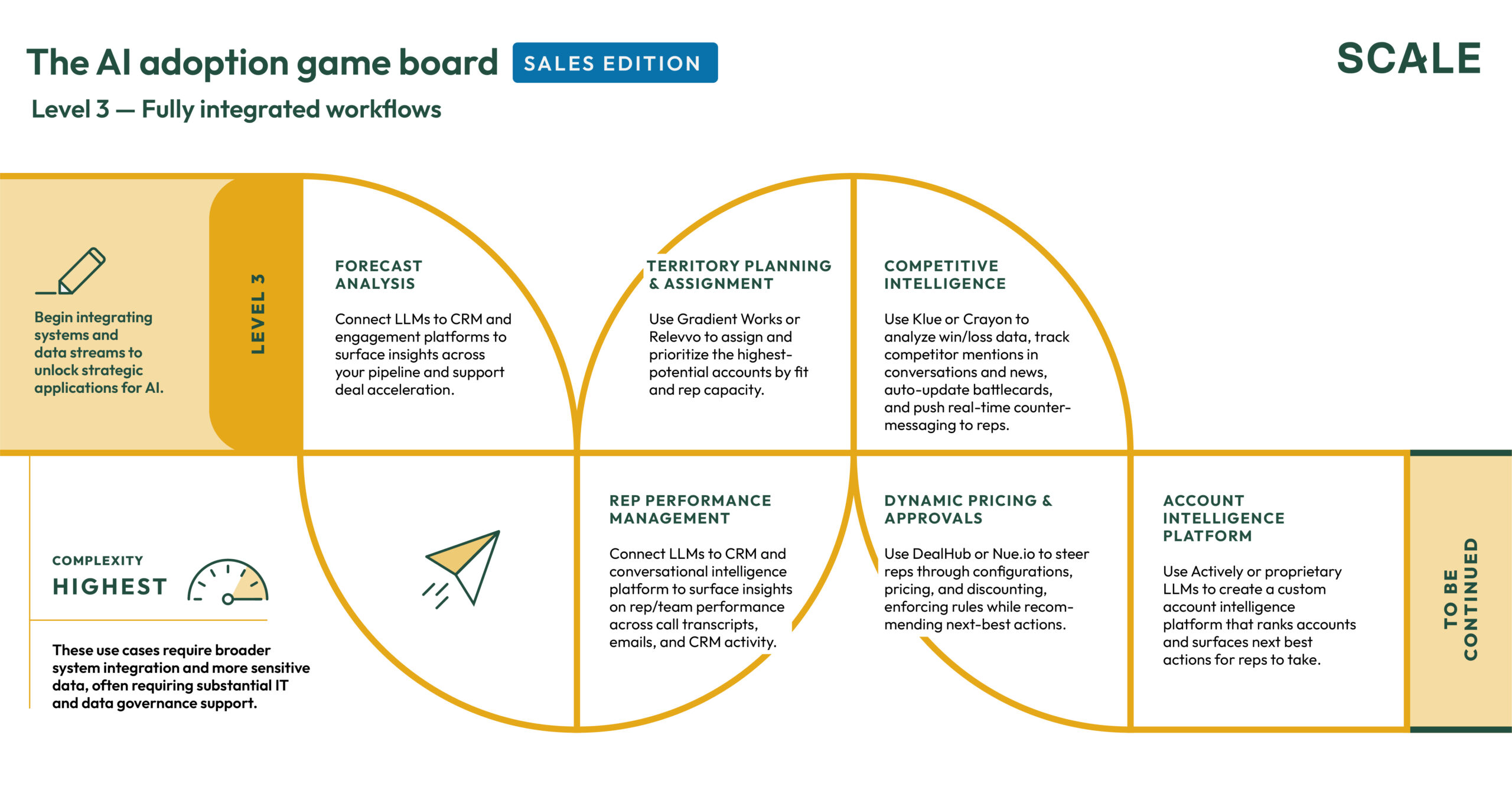
To help your own team along their journey, we give you the AI adoption game board—sales edition.
How the board works
The path moves from lower-complexity use cases to more advanced ones. We designed it this way because one of the hardest parts of adopting AI is knowing where to start. Choosing the wrong entry point—especially use cases with low ROI—can derail adoption before it gets off the ground. Many sales teams abandon LLM pilots not because the technology lacks potential, but because they chased use cases that were too complex or weren’t supported by the right data and culture.
A sales rep’s belief in new tooling can be fragile. All it takes is for a few scores to feel “off” for them to stop trusting the system.
This is why the sales game board is organized the way it is. Start your organization in the low-complexity use cases and as you succeed, move up. Let us explore those levels in detail.
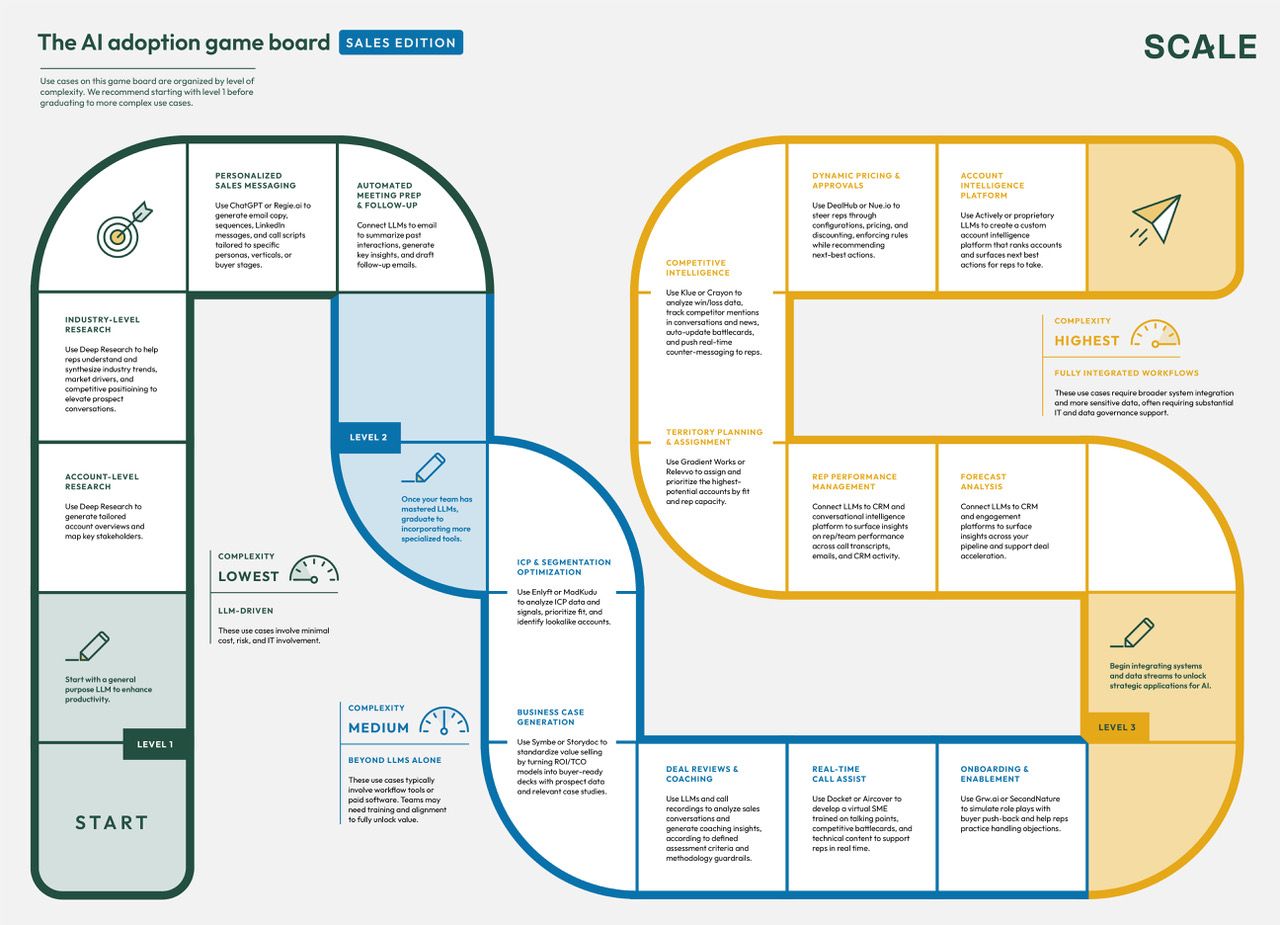
Level 1–Lowest complexity
At the lowest complexity level, it is enough for you to simply get reps excited to use general-purpose AI tools. They can use ChatGPT, Claude, Gemini, and Perplexity to research accounts and industries, or to scan transcripts and recommend messaging. At the more advanced end of this level, sales reps can use AI to summarize past interactions with a prospect to compose an email about next steps.
Some sales tools include this functionality. It is most effective when that model is something the entire team shares. That way, it learns what is working across all reps so everyone has the best knowledge
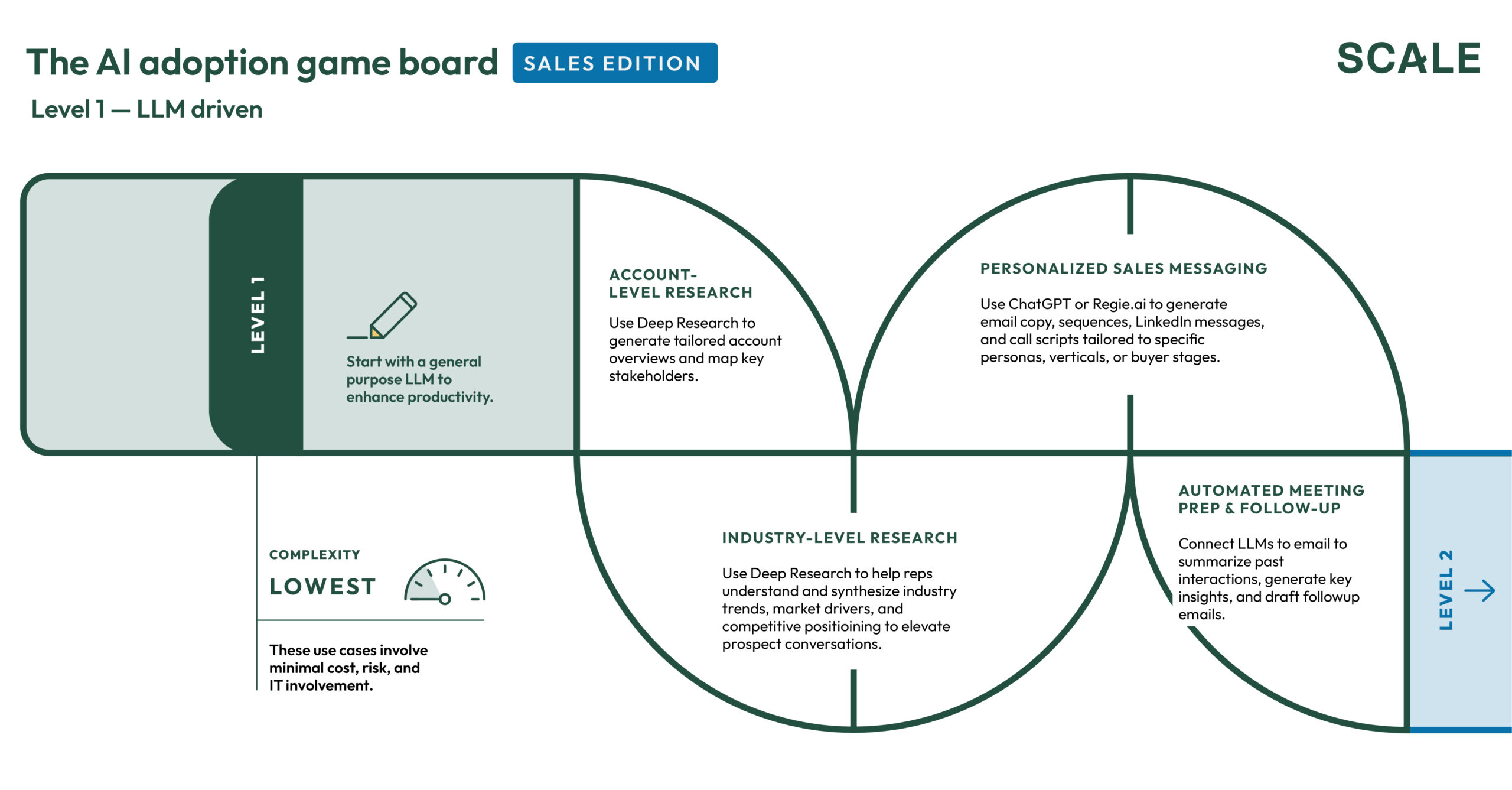
Level 2–Medium complexity
At this level, start thinking about giving AI access to your sales tooling and using it for more strategic tasks, like planning. A model with access to dozens of call transcripts carefully tagged by whether those deals were won or lost can produce a surprisingly apt analysis of what’s required to progress a deal.
Beyond general LLMs, you can use purpose-built tools to examine your existing ICP data to recommend signals and prioritize lists. You can also use AI for deal coaching—combining call transcripts and call scoring criteria into an LLM to surface insights and next steps for reps.
At the upper end of this level, tools like Docket or Aircover can arm reps with a “virtual subject matter expert” to join their calls and help them handle objections.
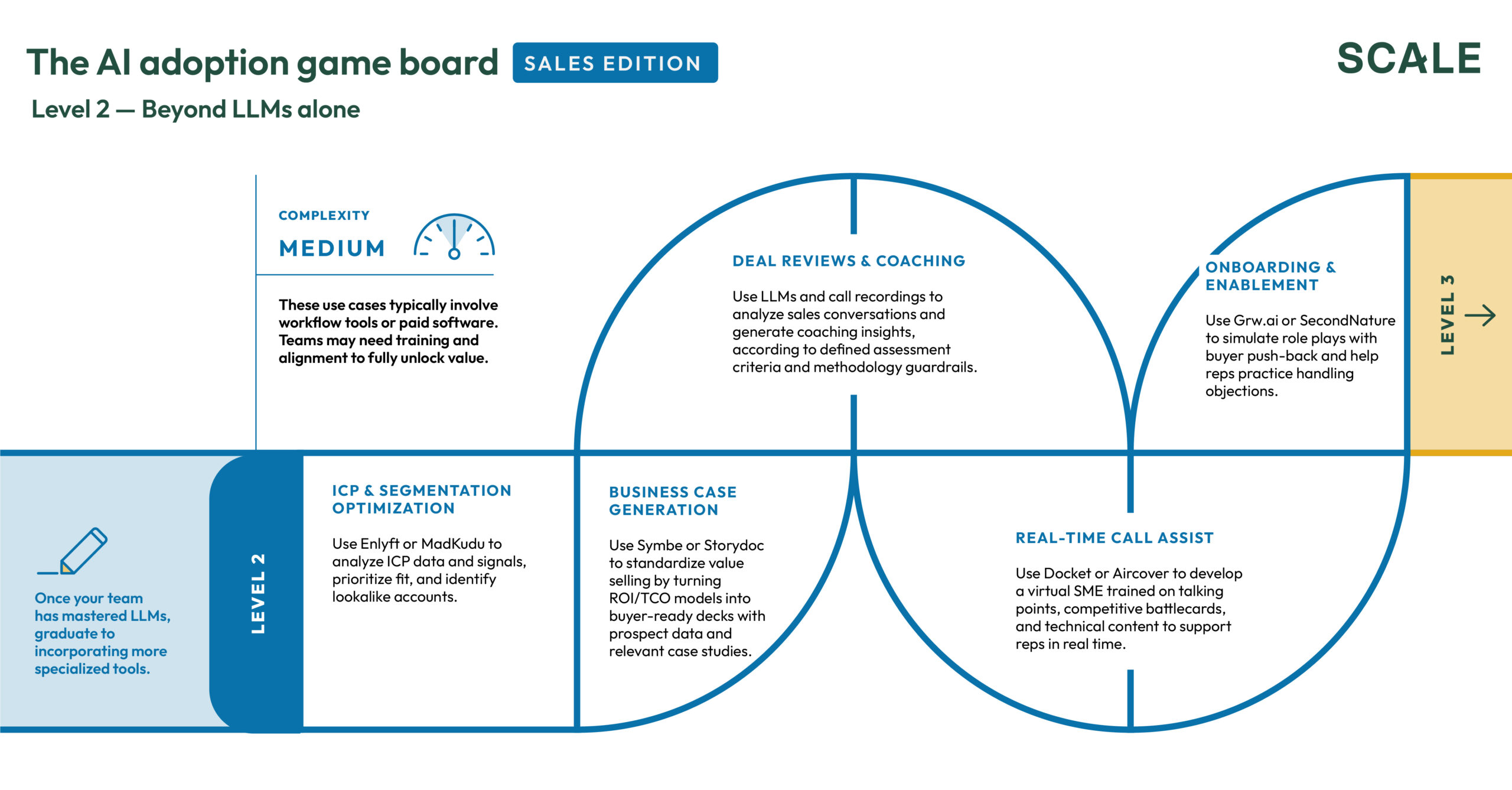
Level 3–Highest complexity
The highest level complexity is about using AI strategically, to help manage your sales org. AI can help analyze forecasts and pipeline to identify at-risk deals, track competitive mentions, and suggest next-best actions. This is where the “workflow” aspect really comes into play—you can use AI to set up a dynamic pricing approval system, with appropriate guardrails, so reps can close deals faster without tying up your head of sales.
Look into Gradient works, Klue, DealHub, Nue, Actively, and more to see how these can empower your entire organization.
To begin, simply begin
As with all change management, you have to signal to your entire sales org that you are serious about deploying AI. Sales reps are creatures of habit. If they sense any hesitation on your part, they will continue selling as they always have and ignore the new tools. Make clear that using AI is the only way forward and make clear that if someone wants to make president’s club, they’d better join the AI club first.