

Motion sells an AI agent-building platform and their sales team runs a high-volume operation. They generate 15-20 sales-accepted leads every day across five account executives, which means their problem isn’t reaching velocity—it’s handling the velocity.
At that speed, it’s difficult to keep everyone on message. Coaching is a rarity and training time, a luxury. It’s also easy for reps moving at that speed to get locked into negative talk tracks or mindsets that lead them to repeatedly lose late-stage deals. “I’m managing five reps that have upwards of 180 opportunities each month so I can’t be everywhere on every deal,” says Antonio Garcia, Head of Sales, “so I needed a way to handle that.”
We invited Antonio to share how he unpacked these challenges and built an automated workflow with AI to coach every rep singularly. The result has allowed them to speed up sales cycles 22% and increase average selling price 23%.
Tools involved: Salesforce CRM, Gong, Copy.ai.
This is part of a series where we invite executives from scaling startups to explain what they’ve built step-by-step in enough detail for others to do the same.
How do you train reps who are on the phone 8 hours a day?
Antonio was previously a VP at Salesforce and knew what an excellent sales culture looked like. But the industry had also evolved, and this time around, rather than hiring a large team, he found himself asking, how could he level-up his reps so new hires could act like people with 10 years of experience?
His challenges were threefold:
1. Reps had no time for training
They take 8-12 discovery calls every day. That affords them ample repetition but no time to reflect, identify weak spots, and train. Managing those reps at that volume, Antonio cannot coach them one-by-one. The team uses a mix of 80% Challenger and 20% Sandler sales methodologies, and Antonio wanted them all consistently resetting on those foundational practices.
2. Antonio had nearly no insight into deal health
Antonio couldn’t read all those opportunity notes nor listen to even a fraction of those calls. Nor could reps effectively summarize their deals—they were too busy focusing on the most promising opportunities. As a result, they were leaving some percentage of winnable deals on the table.
3. Reps were consistently losing late-stage deals
The team was losing a regrettable number of deals post-demo. “This makes my skin crawl,” says Antonio, “because we should very rarely lose once paperwork is out.” It seemed like reps were struggling to take the information prospects were providing and translate it into a clear business case. For example, creating a pitch that a CFO would resonate with, complete with details around the number of projects, sunk hours, and other evidence.
What Antonio built: An AI sales coach within Salesforce
Antonio and one other person with no prior sales operations experience built everything that follows. First, they built their qualification stages on the opportunity object in Salesforce, then a series of Gong custom trackers. “We’re listening for compelling events L1, L2, L3, and so on, for decision-processing criteria,” says Antonio. Reps don’t have to manually input that data, but the higher-quality conversations they have, the better fidelity data it will write to the system, and the better deal scores they’ll get.
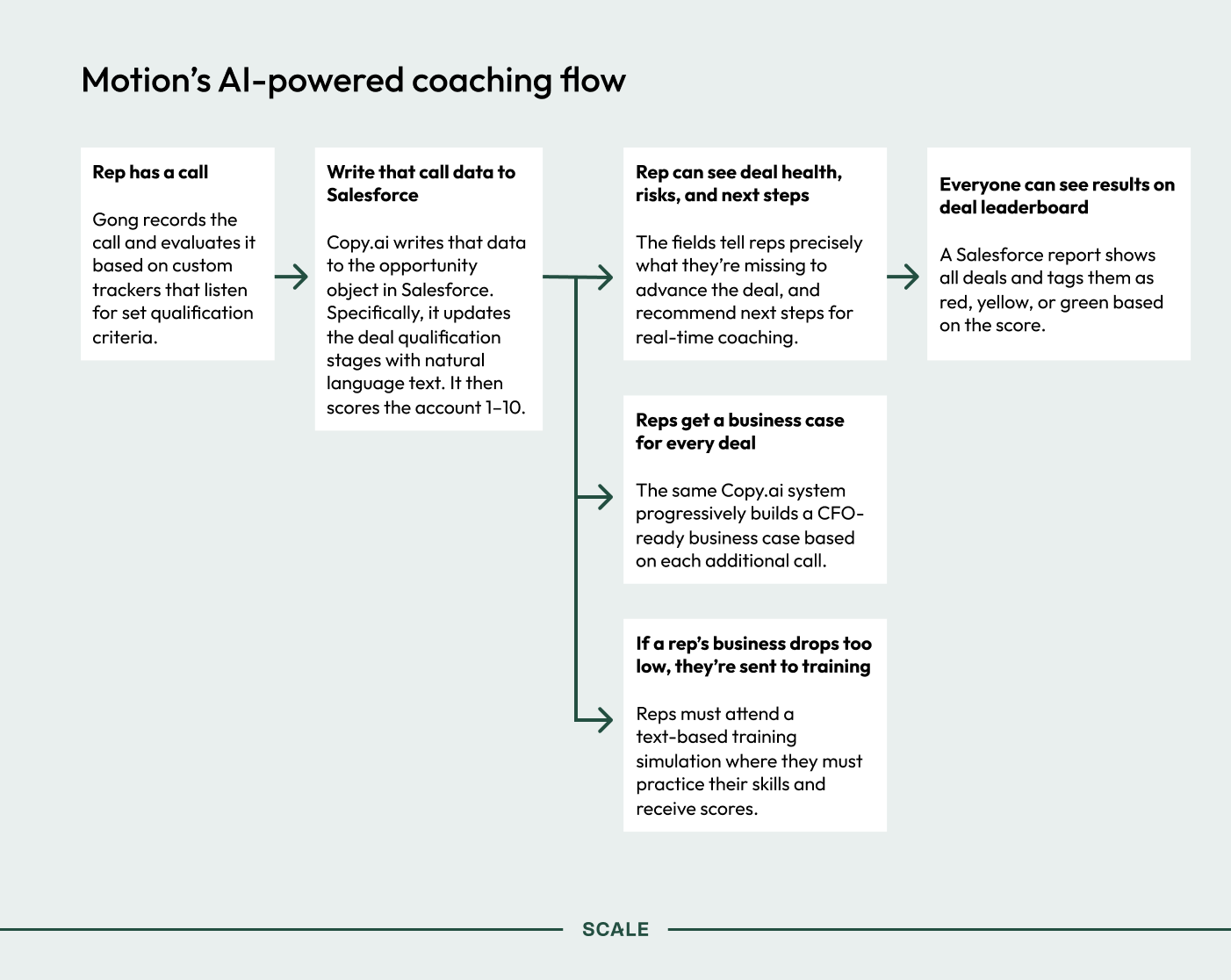
Motion uses this deal data in 3 ways:
1. They created a risk flag to coach reps and report on deal health
They use an Anthropic model on Copy.ai to run a workflow that assesses the deal qualification information. It writes that information to the Salesforce opportunity record and explains what reps need to do to drive the deal forward. It then assigns a numerical score for the overall deal. The result tells reps precisely what they must do, and essentially offers an agenda for the next call.
For example, if an account is having substantial challenges with their existing solution, the bot determines that it’s a good compelling event and scores the deal an “eight.” Whereas if another record is similar but it’s missing urgency and a deadline, the system will advise the rep to go back to figure that out—and it scores the deal lower.
The Copy.ai assessment bot runs after every single Gong call and updates the deal. Though reps can also press a button to manually trigger a re-score—say, if they receive a text or an email, and update the notes themselves. Antonio estimates each run costs $1.50.
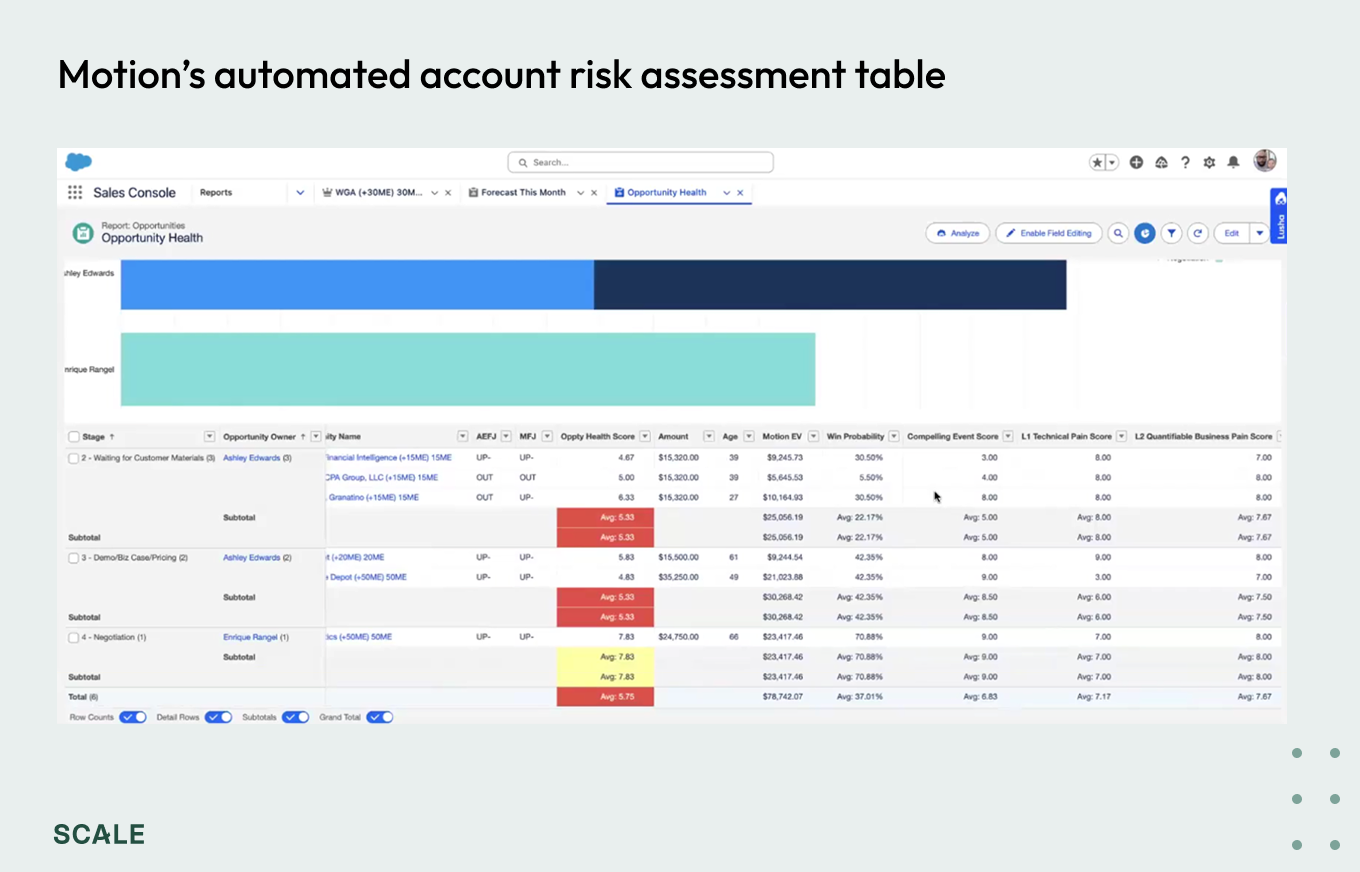
The Copy.ai workflow is useful because it is trained on thousands of hours of call transcripts and recordings of Antonio’s coaching feedback. “The result is my brain sits on their opportunity record and coaches them on those deals,” he says.
Antonio can see the team’s opportunity health scores across the entire fiscal period (currently averaging a 5.33) and by rep and by domain. Those numbers feed into Antonio’s forecast model, which he finds more accurate than other tools like Clari, but less accurate than forecasting himself.
As an added benefit, the resulting internal report is, effectively, a leaderboard.
“The board prompts me to inspect risky deals, and this creates an indirect leaderboard that all reps can see,” says Antonio. “Reps think, ‘Shoot, I don’t want to be at the bottom of this thing. I want my scores to be a lot higher.’ So they’re having some friendly competition to see who can bump more scores from red to yellow or yellow to green. So it’s actually created this great culture that we had no intention of creating. Reps have really embraced it. It’s providing a tremendous amount of value to the team.”
2. They built a business case builder
This automation also uses Copy.ai on a ChatGPT model to analyze those same Gong calls and opportunity record data to progressively construct and refine a business case that a CFO would find compelling—based on prior business cases CFOs have found compelling. It makes a custom reference to the prospect’s pain points, use case, and industry, and helps reps pre-address objections they are likely to receive.
That summary breaks down into return-on-investment calculations and hard numbers. They haven’t refined that to the point where it’s reliably useful, but that’s in the works.
3. They built an AI sales coach
The Copy.ai-based bot also acts like a customer in a text-based discovery simulation where the reps get graded on their performance and either pass or fail. Antonio can measure the progression of their scores over time. “Think of it like batting practice—anytime the rep’s actual quota or business closed drops beneath a certain level, it means they need to go back to the simulator,” says Antonio. “The objection handling, by the way, is hard. I failed the first two times, and I built the thing.”
The result: faster deals, larger deals
Antonio’s automated process is built to keep up with a sales organization that moves at the speed they do—where cycles are short and some deals are one-call closes. The system provides invaluable insight that reps wouldn’t be able to generate themselves along with Antonio’s insight into how it’s all working.
“We’re meeting the reps where they are, giving them my brain on demand,” says Antonio. “And we’ve seen a lift in business because of it.”