Autonomous attackers are here: what changed, what the data says, and what to do



Over the past four months, attacks run by AI agents went from research demos to breaches that landed in the news. An open-source agentic pen-testing framework called ARTEX was released around July and scaled up in September. The FBI says that the framework has been used by attackers since August. Microsoft, CrowdStrike, and others published findings on breaches in October, and the FBI issued a FLASH alert on November 13 encouraging threat mitigation efforts. This month, mainstream organizations are reporting intrusions. Last week, a group of CISOs convened by the Cloud Security Alliance compared notes on what they are seeing. This post combines what was shared there with the freshest public data we could find, and ends with how we are responding at Scale and in our portfolio.
What changed in the last few months
ARTEX connects AI models to a standard penetration-testing toolkit. An operator sets a target and objectives, and the framework does the rest with any local or remote model. Runs are cheap, and the barrier to entry is low: one security researcher at the huddle had it working in under a day. The techniques are mostly ones defenders already know. What is new is that they are automated, tireless, and adapted to each target by a model that has read most of the public internet.
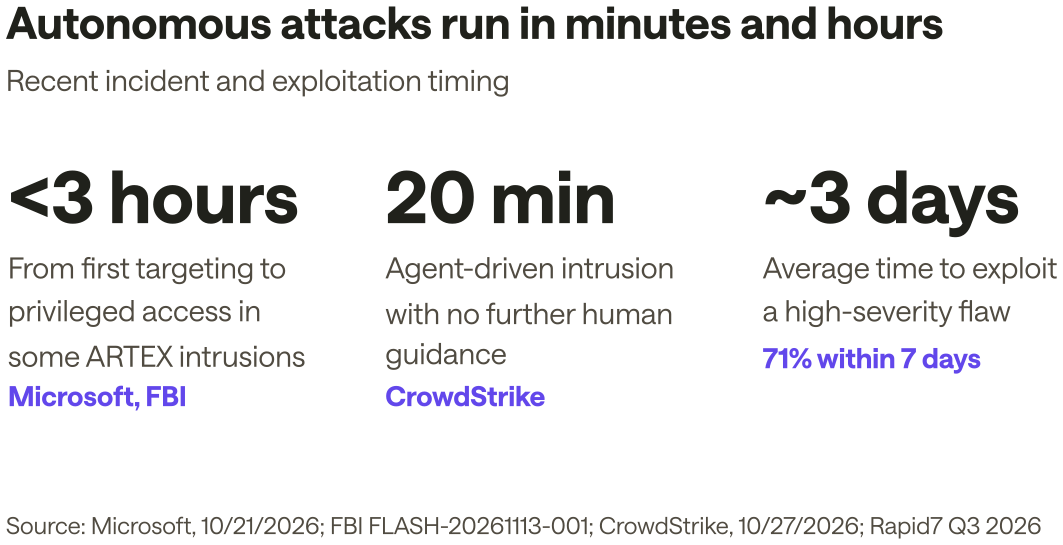
Microsoft and the FBI reported intrusions in which the time from first targeting to privileged access was under three hours. CrowdStrike documented an agent-driven intrusion that ran for 20 minutes with no further human guidance. Rapid7’s third-quarter data puts the average time to exploit a high-severity flaw at about three days, with 71% exploited within a week.
The volume of vulnerabilities has exploded, and it needs careful reading
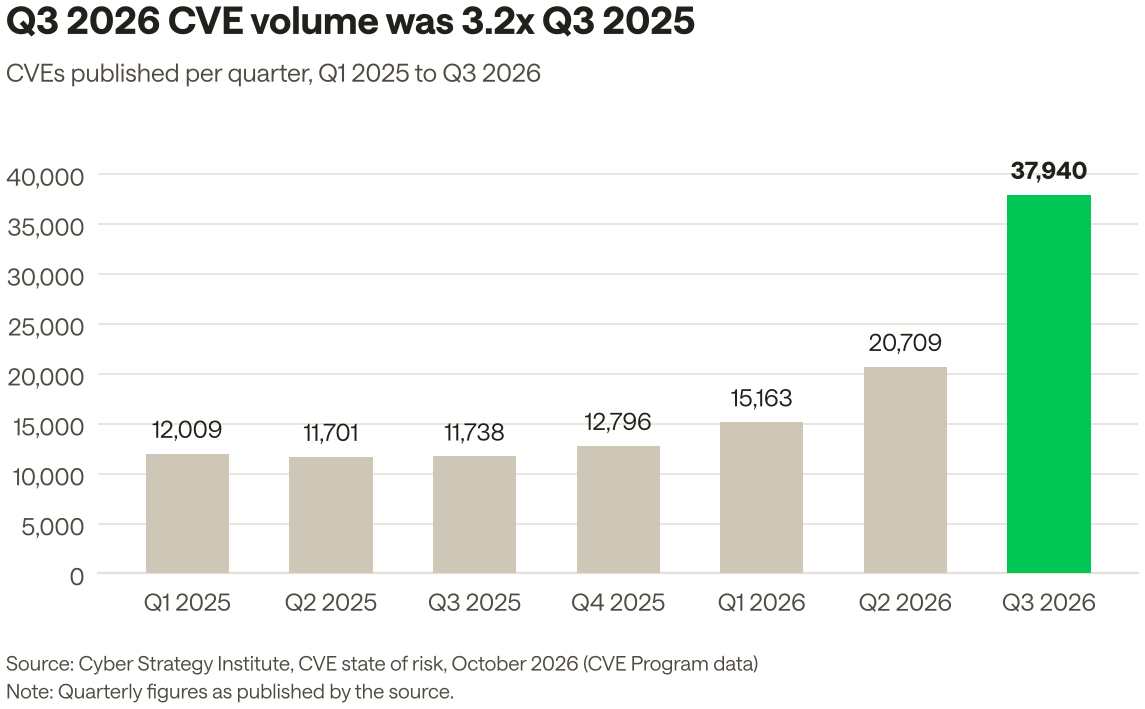
Published CVEs hit 37,940 in the third quarter of 2026, 3.2 times the same quarter of 2025. Through September, 2026 had already produced 73,812 CVEs against 48,244 for all of 2025.
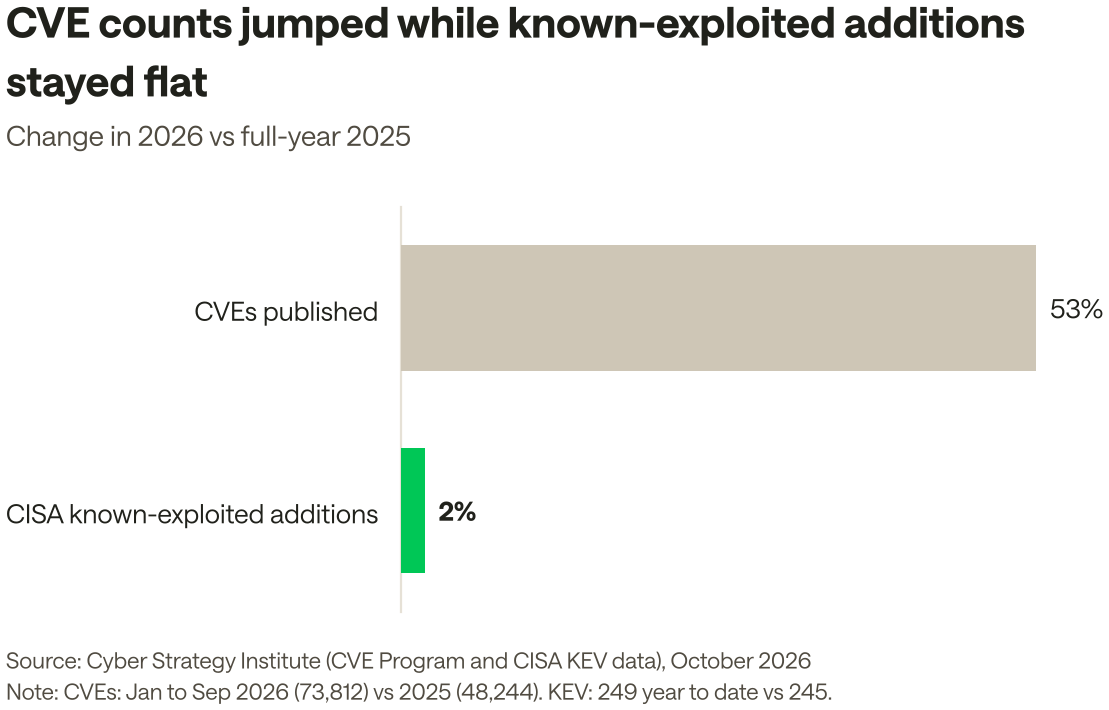
Part of this surge is attackers finding more, and part is defenders finding more. AI-assisted discovery is turning up bugs at industrial scale, and the counting rules for what earns a CVE also matter. The cleanest check is exploitation: CISA added 249 vulnerabilities to its known-exploited catalog this year through the same period, against 245 in all of 2025. Confirmed exploitation is roughly flat while disclosure is up 53%. The pile defenders must sort has grown much faster than the set of bugs actively used against them.
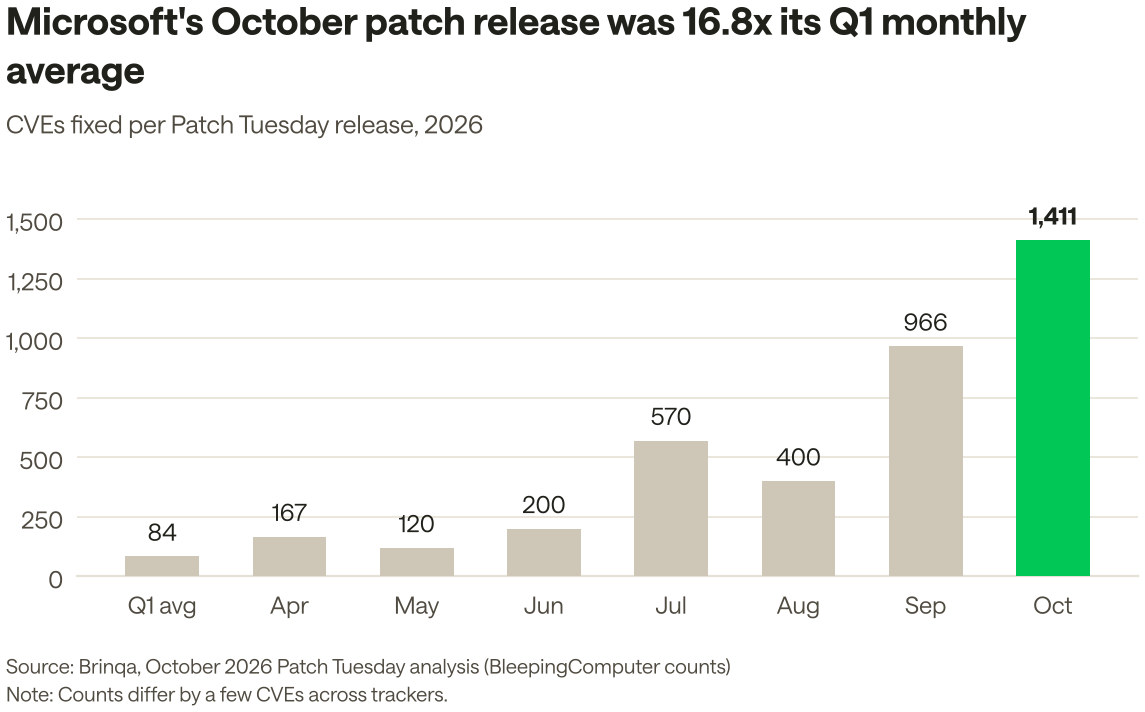
The load shows up in patch releases. Microsoft’s October Patch Tuesday fixed 1,411 CVEs, 16.8 times its monthly average in the first quarter, and every release since June has been several times larger than any in the spring.
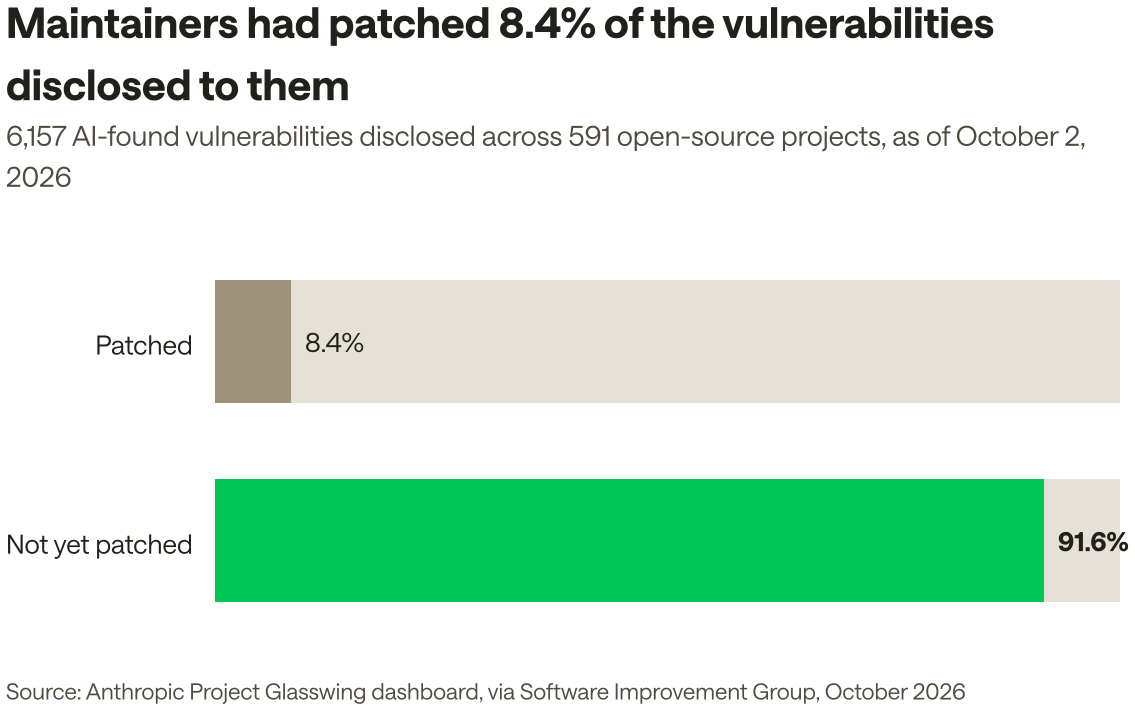
Fixing is also not the same as fixed. Anthropic’s Project Glasswing dashboard, as summarized by the Software Improvement Group, showed that of 6,157 AI-found vulnerabilities disclosed to maintainers of 591 open-source projects, 8.4% had been patched as of October 2. The figures are Anthropic’s own, and maintainers are volunteers with finite hours, but the direction is clear. Discovery now outruns remediation, and that gap is where attackers live.
Ransomware is riding the same wave
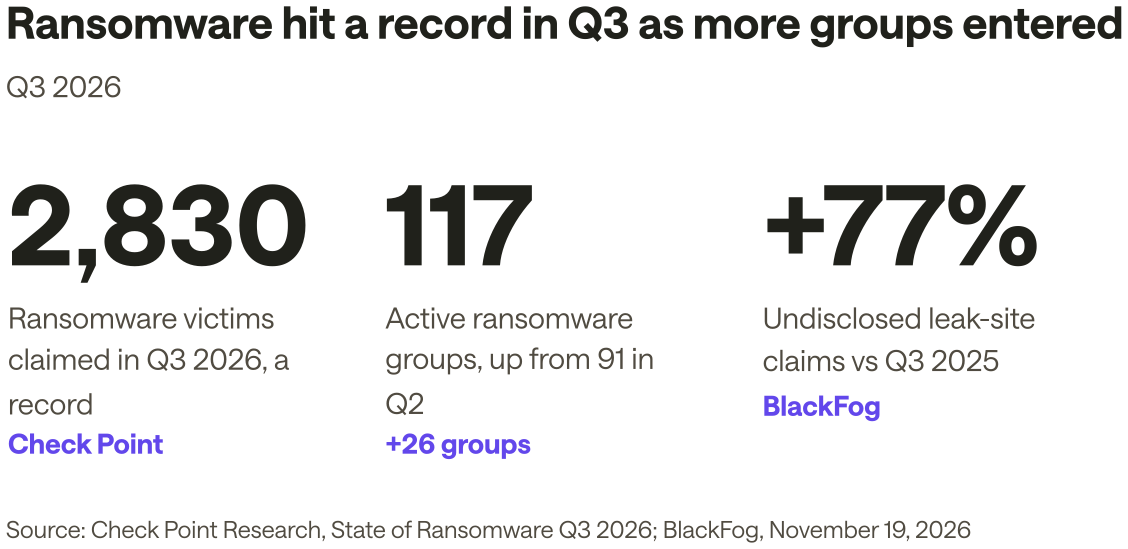
Check Point counted 2,830 ransomware victims claimed in the third quarter, a record, with active groups rising from 91 to 117 in one quarter. BlackFog reports undisclosed leak-site claims up 77% from a year earlier. At the huddle, one responder described a mid-tier ransomware crew that had built its own AI orchestration. When defenders blocked it, the delay bought minutes instead of days: it pivoted around more than 20 obstacles, switched languages and techniques, and shared what it learned across victims.
How these attackers behave
Several patterns came up repeatedly from teams that have handled real incidents. We have kept this to what is useful for defense.
- Your breach will not look like anyone else’s. The harness adapts to each environment using the model’s own knowledge. The same actor, tooling, and infrastructure used very different methods against different targets, including abusing an AI agent environment in one case and reverse engineering a mobile app in another. Indicators of compromise from other victims will help less than usual.
- Quality has risen along with speed. Responders saw rare techniques that used to need a skilled human, such as server-side request forgery through email and abuse of cloud storage uploads to bypass firewalls.
- They are noisy. Reconnaissance enumerates every endpoint and generates heavy traffic. Teams with good logging and endpoint detection saw these attacks quickly. The failure was usually response, not detection.
- They return. Without complete remediation, attackers come back quickly using what they learned or the keys they kept. One red-team agent swarm returned within hours of a fix with a new way in.
- They try to talk your tools out of noticing. Attackers planted fake “authorized research” markers in user agents and files so that an LLM reviewing logs would dismiss the activity. CrowdStrike has reported similar behavior. Any AI reviewer in your pipeline is now part of your attack surface.
- They need money for inference. Running models costs money, so attackers hunt for API keys and service accounts to pay for it. Expect credentials for AI providers, and the infrastructure and proxy services that store customer keys, to be prime targets next year.
- They can also go slow. The same agents can be told to be quiet and patient. Defenders should test against the maximally slow case, particularly in operational technology.
- Models can hold stolen data in context. That removes the staging step defenders have long relied on for forensics.
What is working on defense
- Hack yourself with AI, continuously. The teams doing best run the same kinds of agents against their own environment, with more than one model, since capability varies widely by model. Open-weight models work well for this.
- Use agents for triage. Security signals are high-volume and low-signal, which suits agents. They can watch the long tail and escalate to a human on call. Connect an agent to your security tools so an analyst can ask questions ad hoc.
- Remediate completely. Fixing one hole does not evict an attacker who holds tokens, keys, and knowledge. Rotate credentials, revoke repository tokens after any compromise, and assume the attacker will test the fix.
- Invest in containing and recovering from destruction. In destructive attacks, alerts fired and response was still too slow. Architecture that limits blast radius, plus tested backups and recovery, matters more than winning each individual race. Application allow-listing held up relatively well.
- Monitor before you block. Once logging is solid, watching often teaches more than blocking, and IP blocks are weak against attackers who rotate infrastructure freely.
- Use deception, with care. Some teams are seeing attacker agents obey instructions embedded in responses, which can pause or degrade them. This buys time and is worth testing, but it is one layer, not a playbook, and its details are best kept to defenders.
- Follow the FBI’s hardening guidance. The FLASH alert lists concrete steps that apply directly.
Adopting security agents safely
Several CISOs asked where to start with agents on critical systems. The most useful answer was a progression. First, the agent triages alongside humans. Next, it does most of the work and a human approves each action. Last, it runs autonomously with a human in the loop for consequential actions such as quarantine. Along the way, scope credentials narrowly, push configuration and hooks centrally through device management, and monitor what agents do the way you monitor what people do. Keep an open-weight fallback model available, because frontier-model guardrails can block defenders doing legitimate work.
The double edge of capable agents
Every capability that makes an agent useful to us makes it useful to someone else. An agent that can read a codebase, chain tools, and keep working while no one is watching will do that for a defender or an attacker, and also on behalf of a well-meaning employee who gave it too much access. The same goal pursuit that makes agents productive makes them relentless optimizers: they ask how to reach the goal, not whether they should. Incident responders at the huddle described agents with broad permissions reaching for credentials and keys in ways their owners never intended. More capable agents will make this more true, not less. Our view is to adopt them anyway and treat their permissions with the same discipline as any privileged identity.
Where we are headed
AI red teaming, along with the frontier-model vulnerability-discovery programs such as Mythos and Glasswing, are now regular practice for us, and are no longer pilots. Our internal focus is speed to remediation, pivoting into more dynamic vulnerability detection/remediation, while utilizing the best threat intelligence signals from all sources.
Caveats
- The data comes from vendors and researchers with different populations and methods. Compare direction, not exact levels.
- CVE counts differ across trackers, and some of the increase reflects discovery and counting rules, not new risk.
- Project Glasswing figures are Anthropic’s own, relayed through the Software Improvement Group.
- Huddle accounts are first-hand reports from practitioners, and we have not independently verified them. We have left out identifying details and tactics that would help attackers.
- This is a fast-moving area. Some of these numbers will be stale within weeks.

News from the Scale portfolio and firm