Intelligence isn’t everything: AI models need a better platform to reach their full potential


Intelligence isn’t everything.
LLMs have proven themselves to be geniuses at solving certain problems, from cracking 80-year-old mathematical mysteries to migrating legacy codebases onto modern platforms in a snap. But then, you ask Claude to do something seemingly simple like format a spreadsheet in a certain way, and it just can’t get it right no matter how you prompt it.
In a world where the frontier labs are improving their models at an unbelievable rate, why don’t LLMs seem good enough to rely on for everyday tasks and routine knowledge work?
To answer this question, it’s helpful to take a step back and consider how humans actually get things done. A knowledge worker has access to tools: For example, their own memory, so they don’t have to figure out how to do a task again from scratch every time it comes up, and so they can call up context from previous experiences as needed. They also have a place to do work, in the form of a PC or phone where they can create, edit, duplicate, delete, and publish their work as the task requires.
We believe that LLMs and AI agents will need their own set of tools to deliver the best results. Model quality still matters, especially as advances in LLM development unlock new tasks and improve their reliability and ability to work through a task independently. But we see that another variable is becoming just as important to getting the best outcomes out of these frontier models: the harness.
The harness is everything around the model that turns a model call into an agent that can actually do work such as context management, memory, sandboxing, and observability. The model essentially provides the reasoning while the harness decides whether that reasoning can be turned into an action.
A year ago, many of the conversations we had with founders were about orchestration frameworks or MCP-adjacent tooling. This year, we’ve met with more than 100 agent infra companies, a larger share of whom are not building agents directly, but rather focusing on the pieces of the harness layer.
We think this ends with harnesses allowing agents to become something professionals manage rather than tools they open. Engineers, recruiters, or analysts will each run their own personal agents at work, interacting with them via Slack or any one of a number of other interfaces.
This post will discuss what a harness is, explain why they’ve been a rising topic, and go over the major players building these harness components.
What is an Agent Harness?
An agent is not just a model call. A model call takes an input and returns an output. An agent has to keep working after the first output. It needs to decide what to do next, call tools, read the result, update its state, decide whether to continue, and know when to stop or ask for help.
The harness is the system that manages that loop.
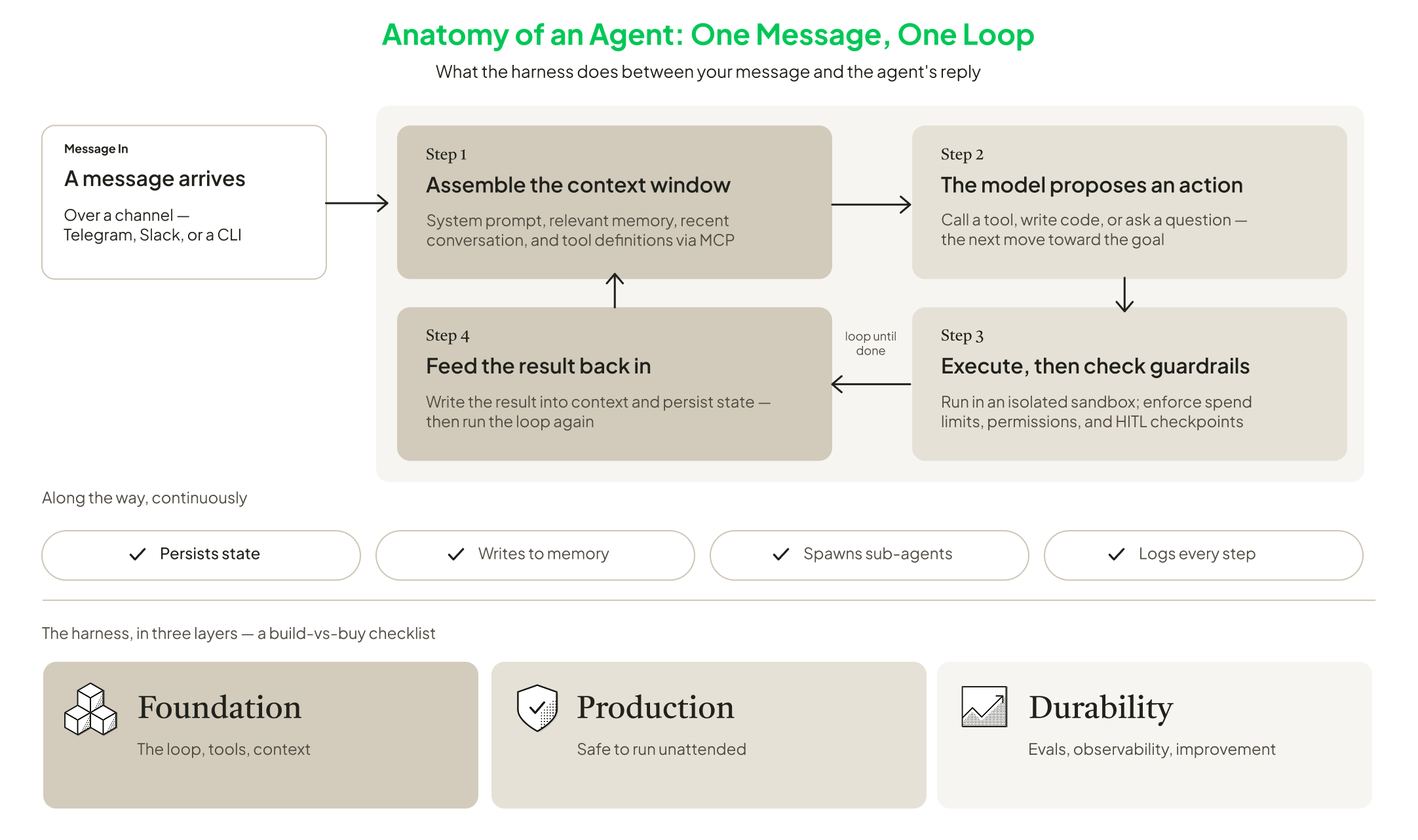
When a user sends a request through Slack, Telegram, a browser, an IDE, a CLI, or a desktop app, the harness manages the work between the message and the reply. It does five things:
- Builds the context: It assembles the system prompt, task history, relevant memory, user preferences, available tools, credentials, policies, and prior actions.
- Asks the model for the next step: The model proposes an action: call a tool, write code, browse the web, ask a clarifying question, delegate to a sub-agent, or return an answer.
- Checks and executes the action: The harness decides whether the action is allowed, whether it needs human approval, what permissions apply, what budget limits exist, and where the action should run.
- Feeds the result back into the loop: The result of the tool call, code execution, browser action, or API call becomes a new observation. The harness adds it back into context and asks the model what to do next.
- Logs, evaluates, and improves: The harness records traces, costs, errors, outcomes, memory updates, approvals, and failures. Those logs become the basis for debugging, evals, regression tests, or training data.
That is why the same model can feel very different inside two different products. One product may give the model better repo context. Another may have safer tool permissions. Another may have better memory. Another may recover better from failed tool calls. Same model, different harness, different product.
Why this matters now
There are a few reasons this layer is becoming more important.
First, harness improvements are starting to move benchmarks even when the model stays fixed. LangChain moved its own coding agent from 52.8% to 66.5% on Terminal Bench 2.0, going from top 30 to top 5 while keeping the model fixed. The changes were system prompts, tools, and middleware — in other words, harness changes. A 13.7-point gain from the wrapper around the model is a pretty good signal that the model is no longer the only thing determining agent quality
Second, tool access standardized first, and the rest of the harness is following. Before MCP, connecting an agent to external tools usually meant building one-off integrations app by app. Anthropic’s Model Context Protocol turned that into a shared standard for tool access. That made “tools” the first harness component people could clearly point to as infrastructure. Now the same thing is starting to happen across the rest of the harness: memory, sandboxes, evals, guardrails, orchestration, and runtime infrastructure.
Third, production failures are showing that agent risk often lives outside the model. Gartner now predicts that by 2027, 40% of enterprises will demote or decommission autonomous AI agents due to governance gaps identified only after production incidents. Additionally, HCLTech's May 2026 survey of 467 senior executives at $1B+ enterprises found nearly 43% of major AI initiatives are expected to fail, attributing the risk to execution and organizational readiness rather than access to tools .The Replit and Cursor incidents made this failure mode more apparent. In both cases, an AI coding agent was given access to a real software environment and ended up deleting production data. The issue was not that the model lacked reasoning ability. The issue was that the system around the model allowed too much freedom: weak separation between development and production, over-scoped credentials, missing approval gates, and insufficient rollback. Those are harness problems.
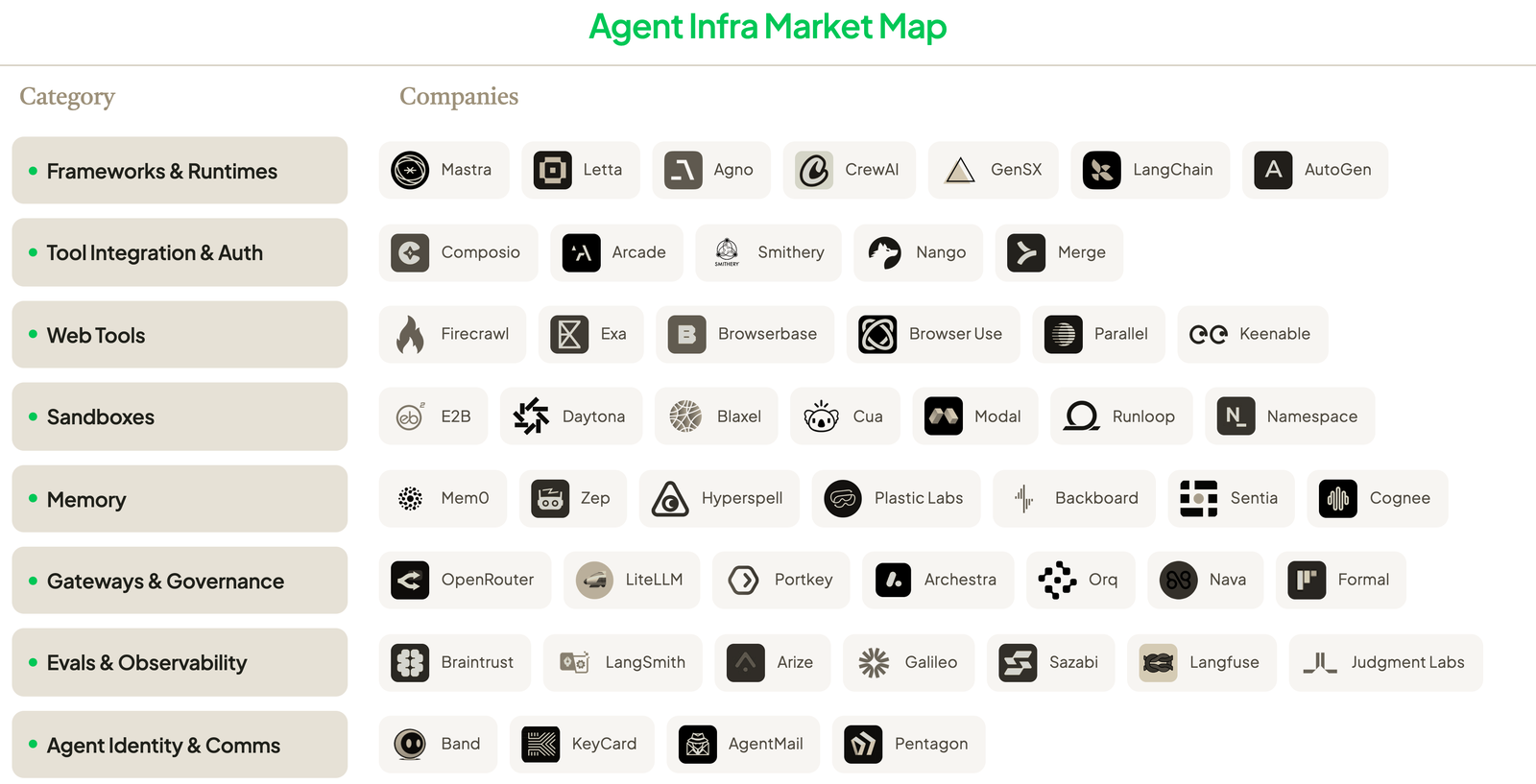
Fourth, the harness components are already becoming markets. A year ago, teams building agents often had to assemble their own sandbox, memory layer, tool auth, and eval infrastructure. In our own meetings over the last two quarters, roughly a third of agent-related companies were not building agent applications at all. They were building pieces of the platform agents run on, including sandboxes, memory, tool auth, browser infrastructure, evals, observability, gateways, governance, and runtime infrastructure. Just last week we saw another example: a team took GPT-5.5 (the current leader on Terminal-Bench 2.1) and added only one harness component: Sentra’s Code Memory. The result was 88.31%, ahead of both Anthropic’s Fable 5 (80.5%) and Mythos 5 (88.0%), while being 3.65× cheaper and using 41.2% fewer tokens. All from a single task-scoped memory layer that prevents the agent from re-reading context it already has. These kinds of gains show why harness engineering is quickly becoming the highest-leverage work in the entire stack.
Agent Infra Stack
A useful way to think about the harness is as the control layer between the user, the model, and the outside world. The harness divides into three functional layers.
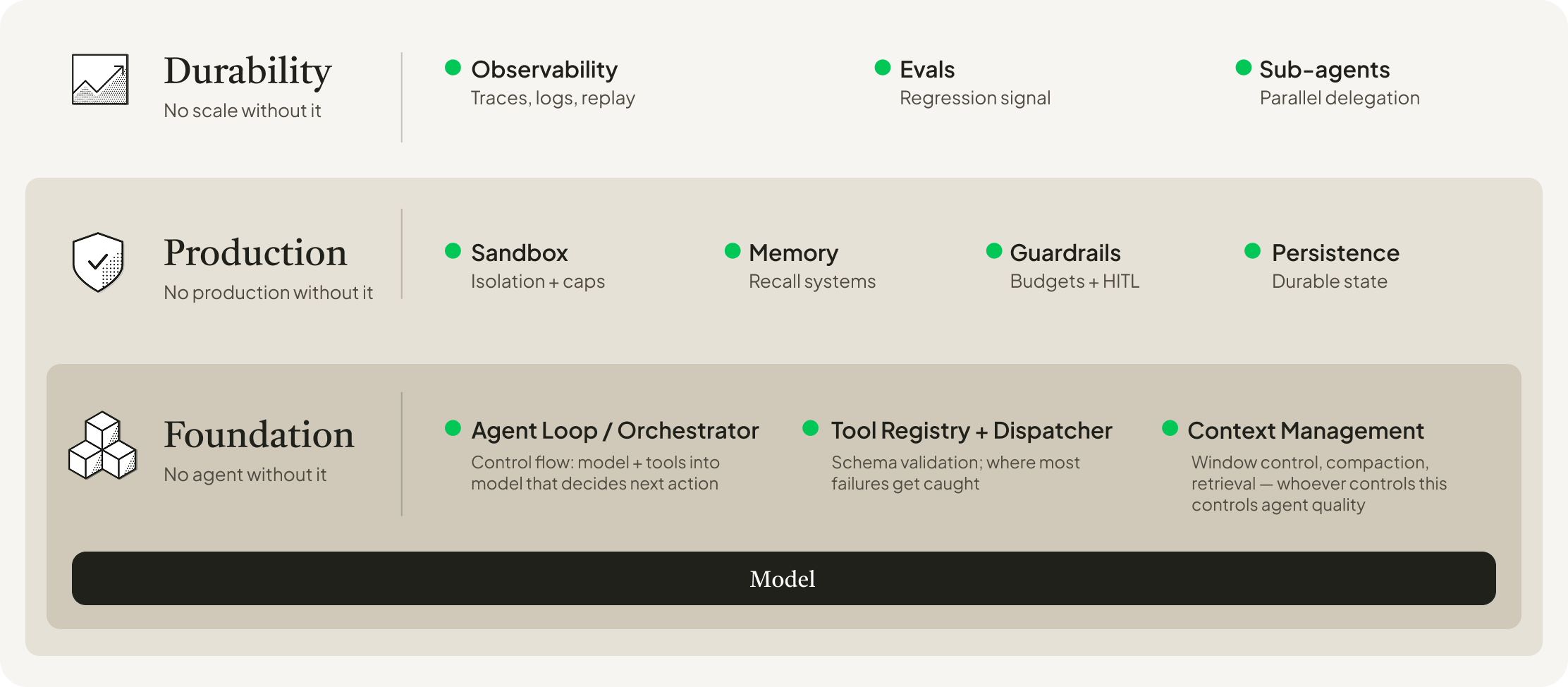
- Foundation (Loop, Tools, Context): This is the core component to the stack. It connects the model, registers tools, controls the context window, and manages the turn-by-turn agent loop. No agent exists without this layer, but generic versions of it are likely to be built by open source frameworks and first-party lab products.
- Production (Safety for Unattended Operation): This layer makes an agent safe enough to run while the user is not watching. It includes sandboxes, identity, permissions, spend limits, durable state, memory, rollback, human-in-the-loop checkpoints, and environment separation. This is where demos become deployable systems.
- Durability (Evals, Observability, Improvement): This layer answers whether the agent is getting better or just getting used. It includes traces, replays, regression tests, benchmark environments, feedback loops, and the RL or fine-tuning infrastructure that converts usage into product improvement. This is where long-term compounding can happen
From there, each layer is becoming its own Market. The important thing is that the stack is no longer just “model plus wrapper.” It is turning into a set of infrastructure markets around agent execution.
Where the Harness Becomes the Product
Once the harness exists, agents start to sort by the surface where users delegate work.
Some agents start in the IDE. Some start in the browser. Some start in Slack or Telegram. Some start on the desktop. Some are local-first. Some are designed to work across all of these surfaces.
The surface determines the initial wedge. The harness determines whether the agent retains users.
A messaging-native agent without memory becomes a chatbot. A browser agent without reliable state management becomes brittle. A coding agent without sandboxing can become dangerous. A desktop agent without permissions and audit logs is hard to trust. In each case, the product experience is determined less by the chat interface and more by the harness underneath it.
The clearest version of this is the omni-surface agent.
An omni-surface agent is not just a chatbot you message, a browser agent that clicks around, or a desktop agent that watches your screen. It needs to take a message from Slack, Telegram, WhatsApp, a CLI, or an IDE; pull context from email, calendar, docs, browser state, repos, CRM, or internal tools; execute the task somewhere safe; ask for approval when needed; update the right app; remember what happened; and report back wherever the user started.
That is the full harness showing up as one agent identity across apps.
Conclusion
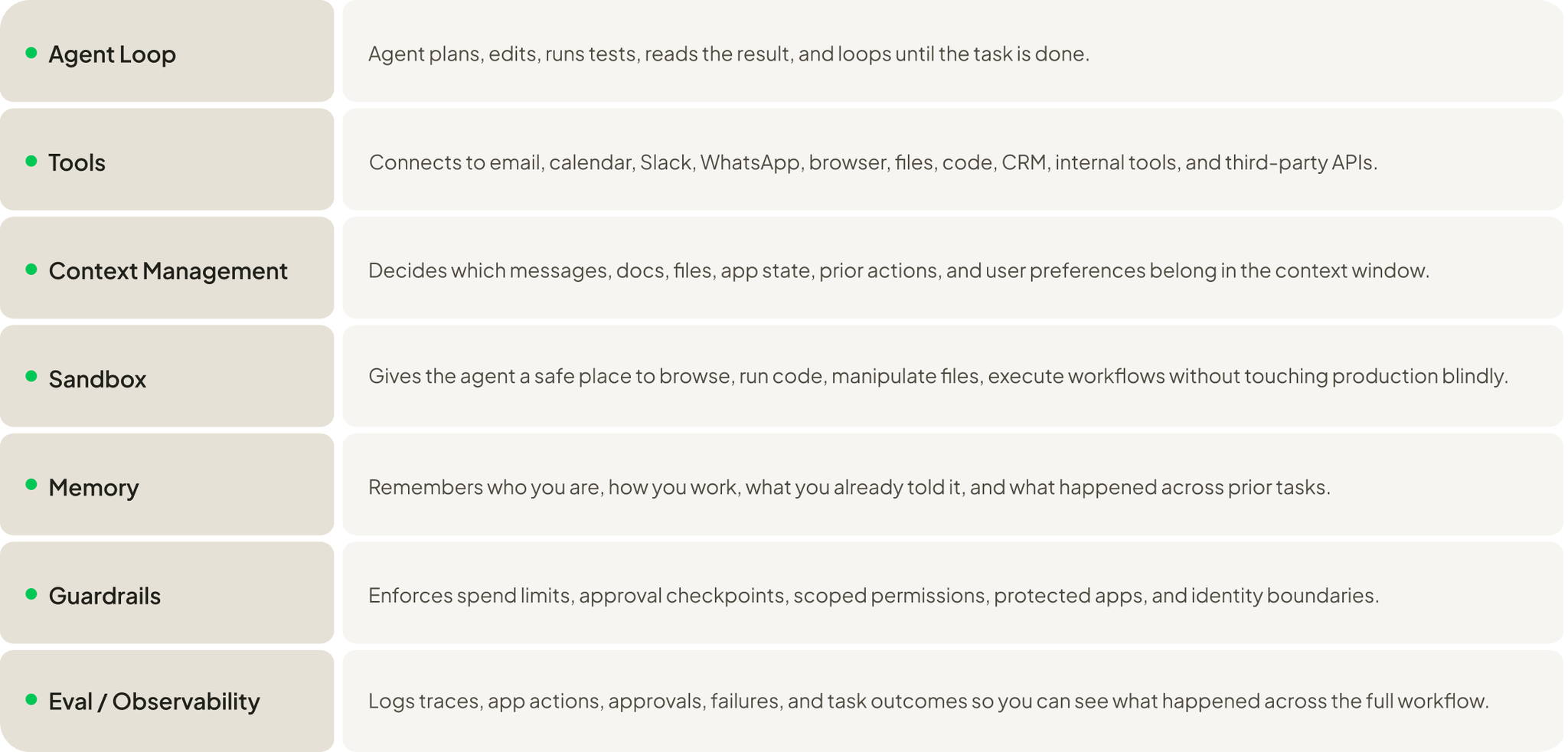
The model used to be the main thing that decided whether an AI product worked. For agents, that is becoming less true. The model still matters, but the bigger question is shifting to what sits around it: the context it gets, the tools it can use, the permissions it has, the environment it runs in, the memory it keeps, the approvals it asks for, and the traces it leaves behind.
This is why the agent stack is starting to look less like a market of wrappers and more like a market of infrastructure. The same thing is happening at the application layer. Coding agents, browser agents, messaging-native agents, desktop agents, and omni-surface agents are not just competing on which model they use. They are competing on whether their harness makes them useful enough to trust with real work. A coding agent needs repo context, terminal access, test loops, protected files, and rollback. An omni-surface agent needs memory, app context, approvals, and the ability to move between Slack, email, calendar, docs, browser, and internal tools without losing state. The product may look like a chat window, an IDE sidebar, or a desktop app, but the product quality comes from the harness underneath.
But managing agents will not look like writing longer and longer prompts. It will look more like writing the onboarding doc just like a new employee: the context, preferences, decision frameworks, permissions, standard procedures, and examples that teach the agent how to work for you.
If you are building any piece of the agent stack, I would love to chat :) Please reach out to me at claire@scalevp.com
News from the Scale portfolio and firm