What it will take to win in robotics


The state of robotics now is unreal. Just in the last month I’ve seen videos of a robot dog doing a flip, Astra controlling a full humanoid robot, Skild performing a 10 min long task with no intervention off one prompt, and Generalist’s GEN-1.5 learning out of distribution tasks.
We've never seen anything like this before, and so when robotics companies are raising at $5B, $15B, $30B+ valuations, it's hard to argue the money is wrong. If a robot can learn a new task from a few seconds of video, there's no reason it stops at the factory. You start picturing it in warehouses, then on construction sites, then in restaurant kitchens, then in your own kitchen, at which point you've arrived at the plot of a movie where things go badly for the humans (except this time everyone is excited about it).
But talk to anyone actually putting robots into a customer's building and the picture changes fast. Businesses buy outcomes, not robots. Automation rates are low, and a surprising amount of the “autonomous” work has a person behind it somewhere. This is normal for how early it is, but it also is the whole problem, because a customer ends up paying for a very expensive demo. A demo can win you a pilot, but a multi-year contract waits for the person to go away and the math to work.
Despite the revolutionary tech, nothing about how businesses think about robots has changed. GM and Ford put robots on their lines in the 70s and 80s because a $50,000 robot ran at a third of the hourly cost of a skilled worker and paid for itself in three years. A warehouse in 2026 will buy a robot the moment the math works, all in, and it will not buy one a day before that. If that moment doesn't arrive for this wave of companies, then in a few years all of this gets remembered as a very well-funded science project.
The most interesting things in robotics right now are happening between what a robot can do in a demo and what it can do in a customer's building at a price they'll pay. The models are undoubtedly getting better very quickly, but closing the deployment gap is what decides whether we end up with 100 million robots doing useful work or a very good collection of videos.
How robots actually get bought
In the inbox of every logistics director in America is a robotics vendor with a very good video. They will watch ~5 seconds of it before scrolling to the part that says what it does to cost per pick, by how much, by when, and what happens to your peak load if it doesn't perform. That's the whole conversation.
The math is unforgiving about everything else. A robot that can learn a new task in two minutes but does this one at 90% reliability doesn't pencil out, because someone has to stand there for the other 10%. And a robot that does the task perfectly at half the speed of a person never gets past the initial email. Classical robotics got very good at passing these tests by narrowing the task until it could excel. This next phase of robotics is predicated on moving beyond these discrete tasks to human-grade complexity, without (at least at first) optimizing the system for the machines, at a price and completion rate that is equal or better than humans, on a time scale that makes sense to boards.
Pareto’s Frontiers
Most jobs involve objects that aren't the same size, buildings that weren't designed for machines, and paths and trajectories that change because navigating in the real world is just hard. Automating those has always failed one of two ways: either it costs far too much to build something that handles every edge case (like in returns where the box might contain a sweater, a blender, or a sweater wrapped around a blender), or you narrow the task until the robot can do it and find you've narrowed it past the point where it was worth having a robot wandering around among your employees.
Now, two things are changing at the same time: the hardware has gotten dramatically cheaper, so the cost of trying a robot on a marginal task has collapsed, and the models have gotten dramatically more capable, so the task no longer has to be narrowed to nothing before a robot can do it. Together these two trends are pushing out the Pareto frontier of what a robot can do much farther.
The hardware side is simple to state. An industrial arm that cost an average around $46,000 in 2010 was $27,000 by 2017 and can be purchased for $10,000 today. And even that understates the cost reduction, because today's arm is a far better machine. The cost of an industrial robot has fallen more than 80% over the last 20 years and is still falling (and that’s not even adjusted for quality). Sensor costs are also cratering. LiDAR on the roof of the first self-driving cars cost about $75,000, and now you can buy something similar for a couple hundred bucks. Compute fell fastest of all: the $99 Jetson board a hobbyist bought in 2019 did about 0.5T operations a second, and its $249 successor does 67T (25x cheaper per flop!).
The price of the hardware sets the floor on which tasks are worth automating. A $150,000 cell has to replace a lot of labor to pay for itself, which is why classical robotics lived in automotive and electronics, where the volumes are enormous. Now, a $10,000 arm costs about three months of one $20-an-hour employee. At that price, a task doesn't have to be high-volume to pencil, it just has to be narrow enough for the robot to do it reliably. Suddenly, there's a long list of jobs—the second shift on a slow packing line, a machine that needs loading forty times a day—where the robot is cheaper or the same price and shows up every day.
The second trend is the one the videos are about. Generalist's GEN-1.5 can watch a person do a task once and then just do it, with roughly a 60% success rate on tasks it has never seen, and five minutes of data on that task takes it over 80%. Skild's S1 does the same from a single video and keeps going for ten minutes at a stretch: potting plants, making pour-over coffee, assembling a kit. Physical Intelligence's π0.7 walks up to an espresso machine it has never seen and makes coffee, on a robot body it wasn't trained on.
These model advancements open up new work that currently can’t be done by “classical” robotics. Places where the objects won't standardize (mixed pallets, returns, a hospital supply room) have always been possible to automate in theory, but never have been worth the money. Work where the goal is fixed but the path isn't (like restocking a shelf that looks different every morning or assembling a part that arrives slightly off each time) was never automatable at any price because there was no path to teach. If the robot can be taught on the job by whoever already does the job, you've removed the engineer and the systems integrator from the budget, and that makes even the boring standard tasks cheaper. That machine that needs loading forty times a day was always automatable, it just never justified six months of integration, and now it might justify an afternoon.
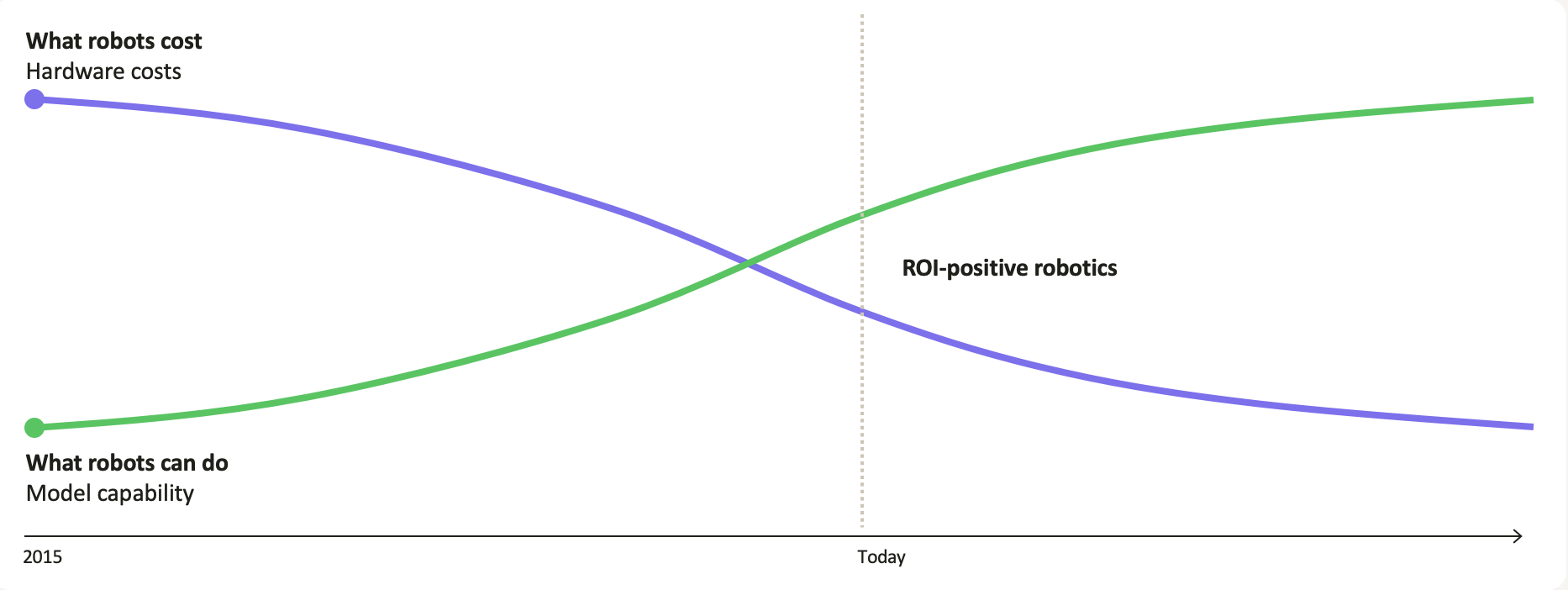
Put the two curves on the same chart and you get the picture that has been driving the money. Hardware cost falls, capability rises, and the frontier of tasks where the math works moves outward for the first time in decades. Things that didn't pencil in 2020 pencil now, and a great deal more will pencil by 2028. That's the case I'd make to anyone who thinks the valuations are silly.
What’s still missing?
The future is indeed promising, but it hasn't yet fully arrived. The models can do things no robot could do two years ago, but there is still work to get them in production at a price a customer will pay. Everyone building in the space agrees on that much, but where they split is on what's actually missing. The companies sort pretty cleanly into three camps depending on their answer.
The first camp says the models need to get better, and that when they do, deployment will follow. This is the model labs: Physical Intelligence, Skild, and Generalist, and the data companies that feed them. The money here is large and getting larger, with $60B since 2023. The data side has gone from a niche to a land grab in about a year, with Mecka and XDOF both raising large rounds, and Micro1, Mercor, and Scale AI expanding their robotics divisions.
The early signs of scaling are there. Generalist's data pile went from 270k hours to over half a million in under a year and the models got more reliable along the way, which is the whole bet in one sentence: if more data and more compute keep producing more reliable robots, then reliability is a spending problem, and spending problems are the kind venture capital knows how to solve.
The data companies are the second-order effect. The labs raised billions on the premise that data is the input, so anyone who can supply egocentric video or teleoperation hours by the hundred-thousand is selling shovels into a gold rush, and the valuations say the buyers agree.
The second camp agrees the models will keep getting better, yet that won't be enough on its own. Even a very good model lands in a building at 95% reliability, and most won’t sign a contract at 95%. Getting from there to the five nines a customer will pay for is work that happens after the model: the process has to be mapped, the edge cases have to be collected and trained on, the safety case has to be built, and all of that only exists inside an actual deployment. So these companies own the customer, own the workflow, own the data, and run the robot themselves while the automation rate climbs.
Watney puts robots in data centers to swap drives and cables, and runs them with teleop in the loop while the models learn the job. Bedrock retrofits excavators and spent a year with an operator in the cab before its first cab-empty deployments in August. Ultra's packing robots at one customer started at roughly 70% autonomy and have worked their way into the 90s on the job. Foundry is the extreme version where it skips the customer entirely and is building its own factory around the robots so it controls every variable. None of this works in a spreadsheet on day one, and it isn't meant to. The bet is that owning the task and the data it throws off lets these companies climb the reliability curve faster than anyone selling a model from outside the building, and that the economics flip somewhere on the way up. It's the riskiest camp and the one that changes the most if it all works out.
The third camp doesn't want to bet on the bottleneck at all. These are robotics companies in the old sense, selling classical automation to buyers who already have a budget line for it, and treating the foundation models as something to add when they're ready rather than something to wait for. Classical automation is getting cheaper for the same reasons all robotics are getting cheaper. For companies already in the space, this means more tasks and more markets are up for grabs. The work might not be viral video-worthy, but it is leading to real revenue. And, when a model shows up that can do the next task over, they have a customer to sell it to and a workflow to drop it into.

We’ve seen a success story in our own portfolio with Locus Robotics. A Locus robot is a cart that drives itself with LiDAR to map the building, its own route planning through aisles that were built for people, and a screen that tells the picker which item and how many. The person currently does the grasping, the robot does the walking, and the whole thing plugs into the WMS the warehouse already runs, so nobody hires a systems integrator for a year. When the buyer is grading on units per hour, every piece of the machine gets engineered around the one task it has to do reliably, at speed.
The pitch to the buyer has almost nothing to do with robots. It's that robotic pickers do 2x-3x as many units an hour as a temp, that new hires spend days instead of weeks getting up to speed on the tooling, that there's no floor to rip up and no racking to move, and that the whole thing is rented by the month, which means it comes out of the same budget the temps did. DHL (not a company known to buy things on vibes) went from 78 units an hour to around 150 at its Locus sites and has now done a billion picks on them.
Who ends up with the money
While not a perfect analogy, there are many ways that robotics mirrors the LLM space: we know the models will get better, that it will take additional work to apply them to concrete tasks, and that some of the work will be done by companies who already have customers.
The foundation model companies are running the same play OpenAI and Anthropic ran, with the same scaling logic and arguably a bigger prize at the end. What I am less sure of is that they capture the same share of the market they create. In software, the distance between the model and the customer was short: an API, some prompting, a UI. In the physical world, even if a model does the task perfectly on day one, someone has to decide which task, map how work actually moves through a particular facility, wire the robot into the WMS and the safety system and the shift schedule, get it certified, insure it, service it when a gripper fails at 2am, and then do all of that again at the next site (which will be laid out differently). If the model is also still learning the job, add the climb from 95% to the number the customer will sign for. The first set of work doesn't go away when the models get better. It's the reason systems integration has existed as an industry for as long as industrial robots have.
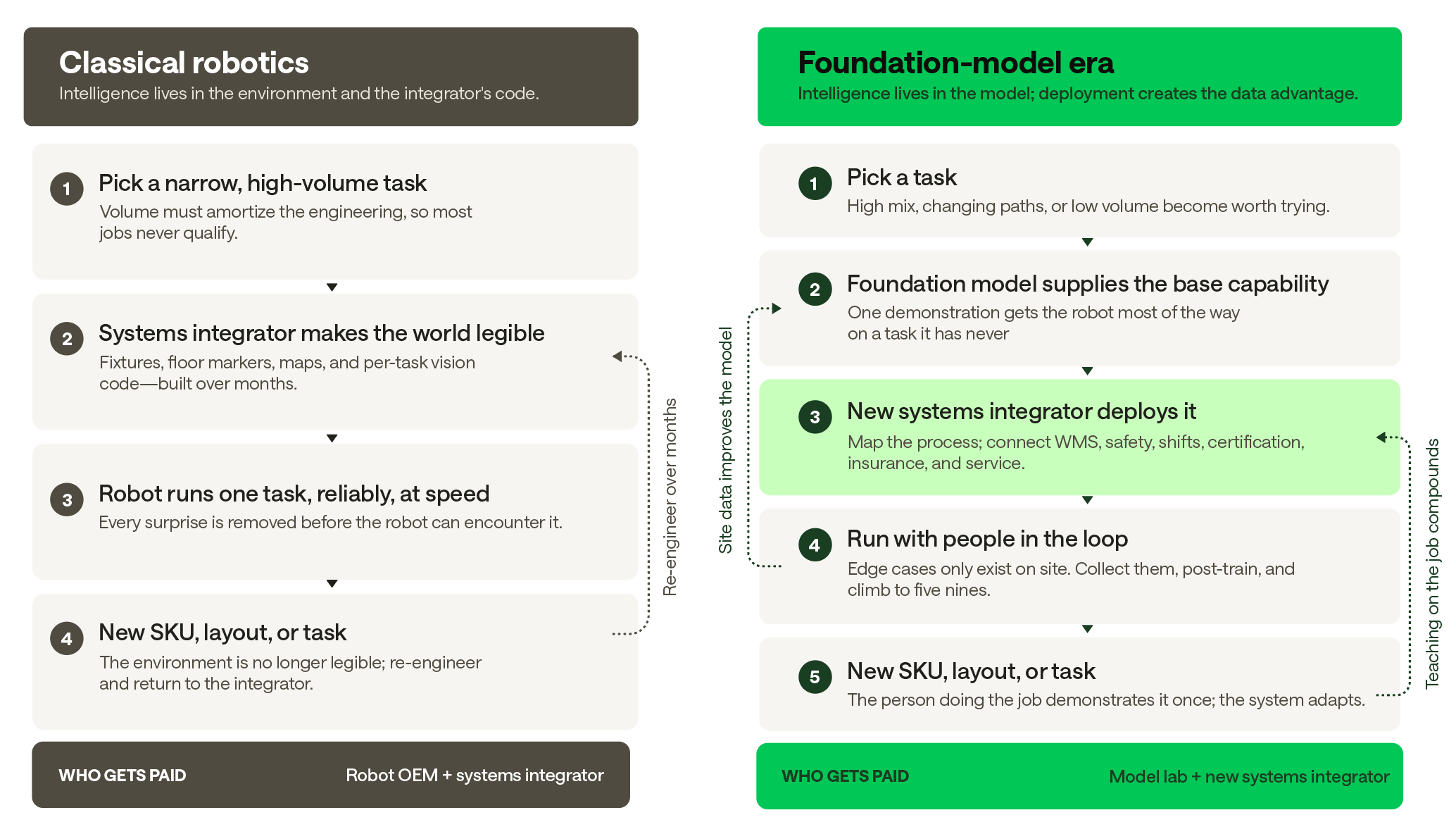
The thing the foundation models change is that the integration layer gets much more valuable, because it's now the difference between a model that can do a task and a robot that does it ten thousand times without anyone watching. The new robotics companies and the classical companies adding new capabilities are, in effect, neo systems integrators, and I think they end up with a larger share of the pie than the integrators ever did.
So when does a new company win that layer, and when does an incumbent? The cleanest answer I have comes from the last time the auto industry bought a lot of robots. In the 1980s, GM spent somewhere around $40 billion on automation (more than anyone) and its plants got less productive. Toyota spent far less, automated selectively, and won on process: the way work moved through the plant, the way problems surfaced, the way the line stopped when something was wrong. When Toyota took over GM's worst plant in Fremont and ran it with the new automation and the same workers, quality went to Japanese levels within a year. The lesson people usually draw is that process beats technology, but more specifically, technology dropped onto a process nobody understood made things worse, and technology added to a process that already worked made things better.
A new company wins when there's no working process to inherit, because the task is new or the job has to be redesigned around the robot: a data center that has never had a maintenance robot, a factory built from scratch for the machines, Kiva rebuilding the warehouse around the pods. The incumbent wins when the process exists and already pencils, because they have the customer, the workflow, the safety case, and the service truck: the new capability is an upgrade to something that already works. The warehouse robot that adds an arm to start picking is going to beat a startup trying to sell the same warehouse an arm with no robot attached.
A brave new world
The forecasts for how many robots exist a decade from now range from Goldman's 6.5 million humanoids by 2035 to Elon's billion within ten years. That spread is the honest state of robotics in 2026.
The models are improving on a curve you can see, the hardware is cheap enough to try, and the set of tasks where a robot pencils is growing for the first time in a generation. What's unsettled is the speed, and the speed isn't set by the models. It's set by how fast someone can take a robot that works in a demo and make it work in a particular building, at a price a person can defend to her CFO, and then do it again in the next one. Whoever gets good at that, whether they started with a foundation model or a fertilizer robot, turns the videos into an industry. Which forecast comes true is just a count of how many of them there are.
News from the Scale portfolio and firm